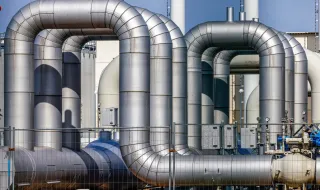
Natural gas prices in Europe rose after traders assessed new signals surrounding the war between the United States and Iran and the possibility of shipping through the Strait of Hormuz being restored. Futures at the Dutch TTF hub, a key price benchmark for the European market, rose 1.6% to €89.52 per megawatt-hour.
The increase followed three consecutive days of declines, during which prices fell by more than 15%. The market is watching to see whether an agreement can be reached to allow shipping through the strategic maritime route to resume. This could increase liquefied natural gas supplies and ease pressure on global energy markets.
Low storage levels maintain pressure
The war with Iran has led to a nearly one-fifth decline in global liquefied natural gas exports. As a result, Europe is entering the winter season with unusually low storage levels, while competition with Asian buyers is intensifying. Prices in Europe and Asia have recently reached their highest levels since 2022, having more than tripled since the beginning of the year.
Gas storage facilities in the European Union are 74% full, compared with an average level of 90% for the past five years at this time. In Germany, the bloc’s largest economy, storage levels stand at 61%.
Due to the colder weather, traders have begun using stored gas more actively. At the same time, electricity generation from wind and solar power has declined. Supplies have also been constrained by unplanned outages on Norwegian gas pipelines, which are operating below their full transport capacity.
Market watches political signals from the US
Democrats have gained control of both chambers of the US Congress. According to the assessment cited by Bloomberg and reported by Ukrinform, this increases their influence over government spending and could limit President Donald Trump’s ability to continue the conflict. However, there has still been little real progress toward ending the war.
“Energy markets are under significant pressure as political changes raise expectations of an end to the war with Iran. From a fundamental perspective, the European gas market remains tight,” strategists at ING Groep NV said.Additional pressure could come from South and Southeast Asia, where buyers are expected to increase their spot-market purchases of liquefied natural gas following the recent decline in prices. The International Energy Agency has already warned of a risk of gas shortages in Europe this winter if the Strait of Hormuz remains blocked and the United States and Iran fail to reach an agreement.
Sources: ukrinform.ua