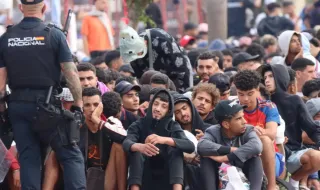
Spanish police have identified 24 suspected Moroccan agents who, according to the investigation, directed migrants toward the border with Ceuta during the mass crossing on July 30. The names and identities of all the individuals are still being clarified, while the case at Spain’s National Court has yet to officially name any suspects.
The materials were prepared by the National Immigration and Border Centre of the Spanish police and submitted to Judge María Tardón. They include video recordings and photographs taken in the Castillejos area, also known as Findiq, on the Moroccan side of the border.
According to the report, some of the individuals were not wearing uniforms and were moving against the flow of people, giving instructions, monitoring movements and talking on the phone. Investigators have prepared separate files on 24 suspected “directors” and a further 10 on uniformed members of the Moroccan security forces.
Witnesses identify Moroccan officials
Spanish police claim that the footage shows uniformed officers remaining passive while groups of people move toward the coast and crossing points. In other cases, people without uniforms can be seen helping women and children reach the shore or directing the movement toward specific locations.
A former Moroccan gendarmerie officer and two migrants have given statements in the case. One of the witnesses identified a local administrative official whom he claims spoke with officers and gave them instructions. Asked whether the man had issued orders, the witness replied: “Yes, at that moment I was giving orders.” The claim forms part of the investigation and does not constitute an established judicial finding of guilt.
The documents also mention a senior security official in the Tetouan area, whom a witness recognized in photographs. Spanish police, however, continue to verify the identities of all the individuals and their roles in the events.
Contradiction with the Spanish government’s position
The mass crossing into Ceuta began on July 30 and continued into the following day. Spanish media cite varying estimates of its scale, ranging from more than 72,000 to around 80,000 people. The discrepancy is due to differing assessments by Spanish institutions and media outlets.
The investigation casts doubt on the official claim that the Moroccan authorities did everything possible to stop the crossing. Spanish Prime Minister Pedro Sánchez told parliament that there was no evidence showing that the Moroccan government had organized the crisis. He allowed for violations and passivity at the local level but rejected the conclusion that state coordination had been proven.
Judge María Tardón is awaiting further police reports, photographs and materials from Spanish intelligence. It remains to be clarified whether the identified individuals acted independently, as part of a local structure, or in coordination with higher-ranking representatives of the Moroccan authorities.
Sources: elpais.com, surinenglish.com, apnews.com