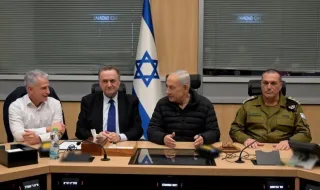
Israeli President Isaac Herzog tasked Gadi Eizenkot with forming the next government, dealing a serious political blow to Prime Minister Benjamin Netanyahu. The decision was made after consultations with all parties elected to the Knesset following the parliamentary vote on October 27.
Eizenkot, leader of the centrist Yashar party and a former chief of the General Staff, received the recommendations of 67 lawmakers. Netanyahu was backed by 46 members of parliament. Neither bloc, however, independently has the necessary 61 seats in the 120-member Knesset.
Among the parties that refused to recommend Netanyahu was United Torah Judaism – a traditional ally of the prime minister. This exposed a crack in his previous bloc, but it is not enough to guarantee Eizenkot a stable coalition.
Arab support is crucial but controversial
Eizenkot is calling for a “government of national emergency” and wants it to be approved as quickly as possible. It is based on four Jewish opposition parties – Yashar, Together, Yisrael Beiteinu and the Democrats, which hold a combined 48 seats.
The candidate has set four conditions for his future partners: that Israel be recognized as a Jewish, democratic, liberal and equal state; that the values of the Declaration of Independence be upheld; that universal service – military, national or civilian – be introduced; and that Hamas be recognized as a terrorist organization.
The last condition effectively rules out the Arab parties’ participation in the cabinet, but they can provide the necessary parliamentary support from outside. A simple majority is sufficient to form a government. To bring it down, however, 61 lawmakers must support an alternative cabinet.
Lieberman presents the main obstacle
The most serious obstacle to Eizenkot’s plan is Yisrael Beiteinu leader Avigdor Lieberman. He rejects a government that would depend on the Arab parties and warns that such a cabinet would be short-lived and would ultimately return Netanyahu to power.
“We will see Netanyahu return with 70 seats for another four years, and from there the road to destruction will be short,” Lieberman wrote.Instead, he called for a “maximum effort” to form a coalition of 61 lawmakers involving Shas and United Torah Judaism, but without the Arab parties. This option directly conflicts with the opposition’s pre-election commitment to universal service. The ultra-Orthodox parties insist on a law that would preserve the exemption of ultra-Orthodox men from compulsory military service, and one of them continues to support Netanyahu.
What comes next
Netanyahu called for a national unity government with his entire political bloc, including the far-right and ultra-Orthodox parties. He said Israel “simply will not survive” if a minority government backed by Arab factions is formed.
Eizenkot’s party described his message as a “pathetic political move” and said that Likud could join a broad government if it ended its alliance with the extremist parties and backed a cabinet headed by Eizenkot.
The first test for the new parliamentary majority will come on Tuesday, when the new Knesset is sworn in. The opposition intends to replace the speaker of parliament, which would allow it to take steps such as establishing a state commission of inquiry into the security failures that led to Hamas’s attack on October 7, 2023.
Eizenkot has 28 days to negotiate ministerial posts, the budget and policy, while the president may extend the period by another 14 days. If he fails, the mandate may be given to Netanyahu for another four weeks.
Sources: edition.cnn.com, apnews.com, timesofisrael.com