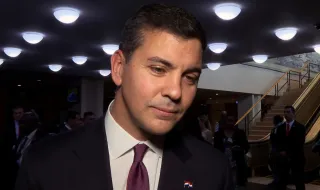
Former Paraguayan President Santiago Peña has been arrested and placed in pretrial detention in the case involving the bankruptcy of Ueno Bank. Judge Humberto Otazú ordered him to remain at the Presidential Escort Regiment in Asunción while prosecutors continue their investigation.
The decision was made after prosecutors brought charges against Peña for breach of trust and self-serving management. The charges are linked to the crisis surrounding Ueno Bank, whose management was taken over by the Central Bank of Paraguay on November 3. According to prosecutors, the collapse of the financial institution affected nearly 3 million customers who were left without access to their savings.
“Pretrial detention is necessary to ensure his participation in the proceedings,” Judge Otazú told reporters after the hearing. According to him, the measure is intended to ensure that the former president remains in the country and appears before the justice system. Prosecutors also requested that Peña’s assets be frozen. If convicted on both charges, he could face up to 20 years in prison.
Removal Following Banking Crisis
Peña was removed from office on November 6, a day after submitting his resignation amid political pressure. The Senate found him guilty of poor performance of his official duties and dismissed him unanimously, with all attending senators voting in favor. Vice President Pedro Alliana was sworn in as head of state and will complete the constitutional term, which expires on August 15, 2028.
An initial house arrest order was issued against Peña on Friday evening. Police notified him of the measure at his home, after which he was taken away under guard. The following day, the former president testified before prosecutors for nearly three hours, but later exercised his right not to answer questions before the judge.
The investigation also covers other financial-sector officials, including former Central Bank chief Carlos Carvalho. Peña rejects the accusations through his defense team, which argues that he poses no flight risk and will not obstruct the investigation. Prosecutors are expected to gather evidence in the case, while the court will rule on the subsequent procedural measures.
Sources: apnews.com, efe.com