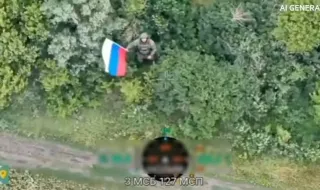
Russian military units and pro-war bloggers are increasingly spreading videos depicting fabricated battlefield successes in Ukraine. The footage shows Russian flags, supposedly captured settlements and Ukrainian servicemen allegedly surrendering, but researchers have identified signs of generation or extensive manipulation using artificial intelligence.
Financial Times reports that the materials are published by Russian military channels and bloggers and are then amplified through state media and messaging platforms. It has not been established that all the videos were produced under a single official order, but experts link them to a broader Russian influence campaign aimed at shaping perceptions of the war.
Fictional captures of Ukrainian settlements
According to Daniel Mealy, a researcher at the Institute for the Study of War, his team has identified around 30 Ukrainian settlements portrayed in videos as having been captured by Russia, even though they remain under Ukrainian control.
He says the aim is to create the impression that the Ukrainian front line is collapsing and that the Russian offensive is constant and unstoppable. In some of the clips, only a single soldier carrying a Russian flag can be seen, but the message is presented as proof that a larger territory has been conquered.
One example of such a post is a video portraying Ukrainian servicemen from the 81st Air Assault Brigade as having surrendered in the village of Piskunivka in Donetsk region. Ukraine’s Center for Countering Disinformation under the National Security and Defense Council declared the footage to be falsified and AI-generated.
The campaign is expanding
The Institute for the Study of War assesses the deepfake videos as part of Russia’s cognitive warfare against Ukraine and its Western allies. According to its analyses, such materials began appearing more frequently in the winter of 2025, including around symbolic dates such as May 9.
Ukrainian officials, quoted by the “Kyiv Post,” claim to have identified more than 1,000 synthetic videos as part of a coordinated disinformation system. The military messages are aimed at weakening morale, while content intended for civilian audiences seeks to undermine trust in institutions and suggest that Russian rule over the occupied territories is inevitable.
Forbes cites data indicating that text-to-video tools such as OpenAI’s Sora were used to create some of the videos. With Sora being withdrawn, Russian sources will likely seek other models, including ByteDance’s Seedance or their own systems.
Dispute over the actual movement of the front
The spread of fake footage coincides with disputes over estimates of Russia’s territorial gains. The Ukrainian project DeepState estimates that in April Russia established control over 141 square kilometers of Ukrainian territory. The Institute for the Study of War’s estimate for the same period is the opposite, indicating a loss of 116 square kilometers of Russian control.
The discrepancy is due to different methodologies and does not in itself prove that either side presented inaccurate data. It does, however, show how difficult it is to establish the actual picture at the front when military claims are combined with increasingly convincing synthetic videos.
Analysts warn that the ultimate aim may be to create an environment in which every image is met with suspicion. In such a situation, authentic footage could also be dismissed as a deepfake, further complicating public understanding of the war’s course.
Sources: ft.com, forbes.com, kyivpost.com