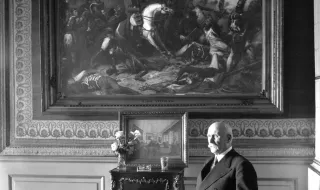
On November 11, 1918, Poland restores its independence after 123 years during which it did not exist as a sovereign state. The day is associated with Józef Piłsudski assuming military command and with the end of hostilities in World War I.
On this date, the Regency Council in Warsaw hands Piłsudski supreme command of the Polish military formations. Three days later, on November 14, the council transfers its remaining powers to him as well. Thus, Piłsudski becomes the central figure of the resurgent Polish state.
The State Disappears from the Map of Europe
Poland is partitioned in three stages between Russia, Prussia, and Austria. The first partition takes place in 1772, followed by new partitions in 1793 and 1795, while the final partition is agreed on October 24, 1795. After that, the Polish state ceases to exist.
Despite the lack of their own state authority, the Poles preserve the political idea of independence. The uprisings in the 19th century are suppressed, while the Polish population is subjected to policies of Russification and Germanization. The change comes with World War I, when the three states that had partitioned the Polish lands find themselves in opposing camps or lose the war.
The War Opens the Way to Restoration
In 1915, German and Austro-Hungarian troops drive the Russian army out of large parts of the Polish lands. On November 5, 1916, Germany and Austria-Hungary announce the creation of the Kingdom of Poland. The project is conceived as a state dependent on the Central Powers and determines neither its final borders nor its full independence.
Józef Piłsudski initially commands Polish legions fighting against Russia. In 1917, he refuses to swear an oath of loyalty to the emperors of Germany and Austria-Hungary. Following the so-called oath crisis, he is interned, while a large part of the legions is disbanded or placed under foreign control.
At the same time, the Polish National Committee is established in Paris in August 1917, headed by Roman Dmowski and Ignacy Jan Paderewski. With the support of the Entente, a Polish army is organized in France under the command of General Józef Haller. It becomes one of the military instruments of the Polish cause in the West.
Wilson Includes Poland in the Postwar Order
On January 8, 1918, US President Woodrow Wilson places Polish independence among the main principles for the future organization of Europe. The 13th point of his program states:
“An independent Polish state should be erected which should include the territories inhabited by indisputably Polish populations, which should be assured a free and secure access to the sea, and whose political and economic independence and territorial integrity should be guaranteed by international covenant.”Thus, the Polish question receives support from one of the leading powers of the Entente.
From Declaration to Piłsudski’s Rule
The first official proclamation of the restoration of an independent Poland is made by the Regency Council on October 7, 1918. The date is sometimes cited as October 6 in popular reference materials, but Polish archival and educational sources identify October 7.
On November 10, Piłsudski returns to Warsaw after being released from prison in Magdeburg. The following day, Germany signs the armistice that ends hostilities on the Western Front, while the Regency Council hands Piłsudski military leadership.
November 11 remains the symbolic date of restored Polish independence. The actual construction of the state, however, continues for years: the lands from the three former partitions must be unified, common institutions must be created, and the borders of the Second Polish Republic must be defined.
Sources: polskieradio.pl, unvis.it