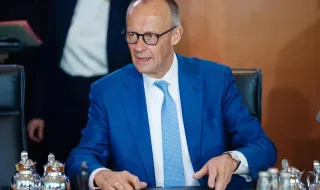
German Chancellor Friedrich Merz insisted that all European Union countries participate in financing support for Ukraine and that this commitment be included in the bloc’s budget. He made the statement at a joint press conference with Hungarian Prime Minister Péter Magyar in Berlin.
“Financial support for Ukraine is a pan-European task. It is not a matter for individual countries, but a collective responsibility of the European Union,” Merz said. In his words, the way Europe will support Ukraine in the coming years, including financially if necessary, must be part of the negotiations on the EU budget.
“It is not a good option to continue along the current path. Policy towards Ukraine must be fully incorporated into the European Union’s budget,” the German chancellor said. He added that he was aware of the differences between the member states, noting that at least four of them held a different position.
The dispute over the 2028–2034 budget
Merz’s statement comes amid a dispute over the EU’s next seven-year budget framework, which will cover the period from 2028 to 2034. The German chancellor has raised the issue of new funding for Ukraine in the context of approving the budget.
Slovak Prime Minister Robert Fico described this as a “textbook case of blackmail” and said that Bratislava could use its veto power. He stressed that Slovakia had the same voting rights on budget decisions as Germany.
According to information cited by European Pravda, Merz has linked German support for the EU budget to a commitment by all member states to participate in financing Ukraine. The condition was set out in a letter to European Council President António Costa.
Four countries oppose the proposal
At this stage, Slovakia, the Czech Republic, Hungary and Bulgaria have opposed the new joint financing for Ukraine. The first three countries have already been exempted from participating in interest payments on the existing €90 billion loan. This mechanism was agreed with the participation of 24 EU countries and is intended for Ukraine’s needs in 2026 and 2027.
Merz recalled that at the end of last year, 24 of the 27 member states had expressed their readiness to provide €90 billion for Ukraine. According to official data from the Council of the EU, the funds are intended both for macroeconomic support and for defence needs.
The issue is also linked to an expected shortfall of around €70 billion in Ukrainian financing in 2027. The European Union plans to cover approximately two-thirds of the amount, or around €45 billion, but the final mechanism has yet to be agreed.
Péter Magyar said that he did not use the term “blackmail”, but did not consider it right for the EU budget and aid to Ukraine to be linked. He pointed out that Hungary could not take on new joint European debt because of its own budgetary difficulties.
Budget negotiations are continuing, and there is still no final decision on how Ukraine will be financed after 2027.
Sources: euronews.com, eurointegration.com.ua