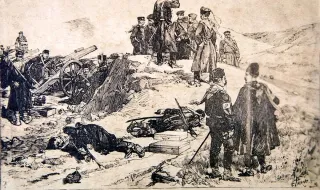
Following the victory at Slivnitsa, the Bulgarian army went on the counteroffensive. On November 10, 1885, Bulgarian forces defeated the Serbian troops at Dragoman, and the retreating units headed toward Tsaribrod.
On November 11, the vanguard of the Bulgarian Western Corps began advancing toward the area around the town. Serbian units from the Danube and Morava divisions took part in the fighting. The battles intensified along the road to Tsaribrod and on the heights around Neshkov Vrah.
The Fighting Continues for Two Days
On November 11 and 12, Bulgarian troops attacked the Serbian positions, with the fighting ranking among the fiercest of the campaign after Slivnitsa. On November 12, Bulgarian forces captured Tsaribrod and drove the Serbian units back toward Pirot. The town, which is today known as Dimitrovgrad, is located in Serbia.
The Bulgarian victory at Tsaribrod opened the way for the next advance. On November 13, Serbian forces withdrew toward Pirot, and on November 14 and 15, the Bulgarian army fought a decisive battle and captured the town.
The Memory of the Battle
The victory at Tsaribrod has remained firmly rooted in the memory of the local population. At the beginning of the 20th century, November 12 was observed as a town holiday, with a memorial service for the fallen and a solemn tribute at the military graves.
In a telegram to the widow of Captain Ivan Zlatev, who died in the fighting, Mayor Vradlovski wrote:
„Today, the citizens of Tsaribrod pay deserved tribute to your unforgettable husband, Captain Zlatev, who fell heroically.“
The battles at Tsaribrod were part of the Bulgarian counteroffensive that changed the course of the Serbo-Bulgarian War. After Pirot was captured on November 16, an armistice was concluded.
Sources: bta.bg, btvnovinite.bg