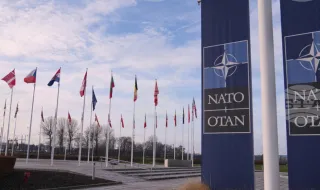
NATO’s military plans to defend Europe are facing political uncertainty in the US, France and Germany. The Alliance has an operational plan for action in the event of a potential conflict, but its implementation depends on government decisions and their readiness to provide troops, weapons and command resources.
“My theory of victory is simple: we will stop the initial attack. If it continues, we will blunt it and prevent any advance by the adversary. If necessary, we will destroy its forces and the system that supports its combat operations,” said NATO Supreme Allied Commander Europe General Alexus Grynkewich at a forum in Warsaw.
At the same time, the general made it clear that the specific involvement of US forces cannot be determined solely by military plans. “Ultimately, it is a political decision who will provide troops and where,” he said. Grynkewich stressed that US forces are currently deployed along the Alliance’s eastern flank.
Washington Assures Allies but Reassesses Its Presence
Following the midterm elections in the US, Washington’s ambassador to NATO, Matthew Whitaker, said that American foreign policy was not changing. “I do not expect the midterm elections to lead to a change,” he said at the Berlin Security Conference, adding that the US remains committed to the entire NATO treaty, including Article 5 on collective defence.
However, the assurances come against the backdrop of a review of the US military presence in Europe. Donald Trump’s administration is insisting that European countries assume a greater share of the costs and capabilities needed to defend the continent. This is increasing concerns among allies that future decisions in Washington could change the US forces and resources available to NATO.
US capabilities are particularly important for air superiority, long-range strikes, intelligence and air defence. Europe’s defence industry is growing, but according to analyses, some of the potential shortfalls will not be able to be offset until the end of the decade.
Elections in France and Germany Add a New Risk
France will elect a president in 2027. Marine Le Pen, one of the leading candidates, said again in September that the country should leave NATO’s integrated military structures. She specified that this should not happen while the war in Ukraine continues. Jean-Luc Mélenchon also opposes the Alliance.
Such a change would raise questions about France’s participation in NATO battlegroups in Estonia and Romania, as well as about a possible European military mission in Ukraine after the end of hostilities.
In Germany, the government is planning to rearm and prepare the army for a possible conflict by 2029. However, the implementation of these plans could be affected by the outcome of the federal elections held that same year. The Alternative for Germany is leading in some polls, and the party has differing positions on Germany’s role in European defence and its relations with Russia.
Against this backdrop, European allies are reporting more cases of sabotage, cyberattacks and incursions by drones and other aircraft into NATO airspace. There is no evidence of imminent preparations for a conventional Russian attack, but the combination of hybrid actions and political uncertainty is making it harder for the Alliance to present a unified and credible deterrence plan.
Sources: devdiscourse.com, apnews.com, lemonde.fr