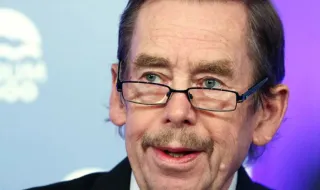
On 17 November 1989, a student demonstration in Prague, which began as a march commemorating Jan Opletal, a student killed by the Nazis, turned into a confrontation with the security forces. This police intervention marked the beginning of the Velvet Revolution, which brought communist rule in Czechoslovakia to an end within a few weeks.
About 15,000 students gathered in the Albertov district and continued towards the city centre, although permission had been granted only for a commemorative march to Vyšehrad. On Národní Street, the demonstrators were blocked by police and security-force units. Around 600 people were injured, according to Radio Prague. After the events, a rumour spread that a student had been killed, but the information proved to be false. The violence itself, however, triggered widespread public anger. Former student leader Monika MacDonagh-Pajerová later described what happened in these words: “It was a real massacre.”
From a Student Strike to a Nationwide Protest
On 18 November, Prague students declared a strike, and actors and theatres joined them. The following day, the Civic Forum was established in Prague, bringing together opposition groups and becoming the main political representative of the protesters. One of its best-known figures was the playwright and dissident Václav Havel.
The protests quickly spread beyond the capital. Every day, tens and hundreds of thousands of people gathered in Wenceslas Square, demanding free elections, civil rights and an end to the Communist Party’s monopoly.
The climax in Prague came on 25 November, when hundreds of thousands of citizens gathered at Letná Plain. Different historical estimates put the number at between approximately 750,000 and 800,000 people, rather than 1.5 million, as is sometimes claimed. The following day, another mass rally was held at the same location.
The Constitutional End of One-Party Rule
On 27 November, a general strike was held across Czechoslovakia from 12 noon to 2 p.m. Students, workers, employees and citizens from different cities took part. The strike showed that the protest was no longer limited to universities and cultural circles.
On 29 November, the Federal Assembly removed from the Constitution the provision defining the leading role of the Communist Party of Czechoslovakia. This eliminated the constitutional basis of its political monopoly, established after the communist coup in 1948.
On 10 December, President Gustáv Husák appointed a government of national understanding headed by Marián Čalfa. For the first time in four decades, the communists no longer held a majority in the government. After the ceremony, Husák resigned.
The transition was completed on 29 December 1989, when the Federal Assembly elected Václav Havel president of Czechoslovakia. Thus, the protest that began with a police crackdown on students in Prague grew into a peaceful transfer of power.
Sources: archiv.radio.cz, ct24.ceskatelevize.cz, artsandculture.google.com