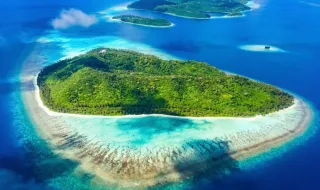
Rising sea levels and the increasingly severe consequences of climate change are forcing residents of Pacific island nations to leave their homes and seek refuge on higher ground. For some communities, however, the options for relocating to safety are gradually running out.
The alarming situation was highlighted by Munkhtuya Altangerel, a representative of the United Nations Development Programme (UNDP) for the Pacific region, during the 31st United Nations Climate Change Conference (COP31), being held in the Turkish city of Antalya.
“The residents I meet in the field take me by the hands and ask: ‘How much farther do we have to move?’ They say there is no longer any safe place where they can escape the climate crisis,” Altangerel said.
The situation is particularly severe in the Solomon Islands, located about 2,000 kilometers northeast of Australia. The archipelago comprises six major islands and more than 1,000 smaller ones, many of which are highly vulnerable to rising sea levels.
According to the UN representative, one of the coral islands began gradually sinking about a decade ago and by 2021 had been completely submerged by the ocean. More than 100 residents were forced to evacuate to a larger island, but conditions there subsequently also became dangerous, necessitating another relocation to higher-lying areas.
“The islands are sinking, rainfall is declining, leading to water shortages, and harvests are shrinking as waves wash away the land,” explained Altangerel, who is responsible for UNDP operations in ten Pacific island nations.
According to her, exceptionally high tides, which previously occurred approximately once a year, are now reaching up to six times a year. Powerful waves are destroying even the protective structures built around inhabited islands.
The climate crisis threatens not only homes, but also access to drinking water, agricultural production and the traditional way of life of local communities.
Altangerel called on the international community to take more decisive measures to curb climate change and support the worst-affected countries.
She expressed gratitude to South Korea for the financial support provided through the Korea International Cooperation Agency (KOICA). Since 2019, Seoul has allocated $7.5 million to the “Governance for Resilience” (Gov4Res) project, aimed at strengthening Pacific countries’ resilience to climate-related disasters.
The initiative is jointly funded by South Korea, Australia, New Zealand and the United Kingdom and, according to the data presented, has supported approximately 390,000 people.
KOICA’s financial contribution is due to end in December, and Altangerel expressed hope that South Korea will continue supporting efforts to adapt to climate change in the region.
For small island nations, rising sea levels are no longer merely a long-term environmental threat, but an immediate problem leading to the loss of territory and the forced displacement of populations.