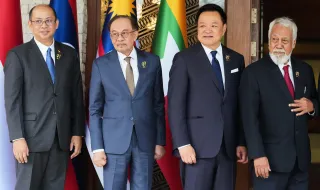
Leaders of the Association of Southeast Asian Nations (ASEAN) gathered in Manila for a three-day summit dominated by energy disruptions, trade disputes and tensions in the South China Sea. The forum runs until November 17 and includes talks with representatives of the United States, India, Canada, Brazil and Russia.
ASEAN comprises Indonesia, Malaysia, the Philippines, Singapore, Thailand, Brunei, Vietnam, Laos, Myanmar, Cambodia and Timor-Leste. The bloc’s population is nearly 694 million. The organization aims to build a single market, but does not have the authority to impose decisions on its members.
U.S. President Donald Trump is expected to attend a special meeting with ASEAN countries on November 17. A bilateral meeting with Philippine President Ferdinand Marcos Jr. is also scheduled. Trump is then due to travel to China for the Asia-Pacific Economic Cooperation summit on November 18 and 19.
Other guests include Indian Prime Minister Narendra Modi, Canadian Prime Minister Mark Carney, Brazilian President Luiz Inacio Lula da Silva and Russian Foreign Minister Sergey Lavrov. Lula da Silva’s visit is the first by a sitting Brazilian president to the Philippines. Carney will deliver a speech, while Lavrov’s participation follows the Russia–ASEAN summit in July.
Countries in the region are among those hardest hit by the shortage of oil and gas linked to the conflict between the United States and Israel and Iran. The Philippines, Vietnam and Malaysia have been identified as particularly vulnerable, while Manila declared a national energy emergency in March. There are concerns that the conflict could also affect the Strait of Malacca between Indonesia, Malaysia and Singapore.
Trade relations are also under pressure. According to Al Jazeera, U.S. tariffs on ASEAN countries have increased by between 10 and 12.5 percent since the start of Trump’s second term, encouraging the bloc to seek closer ties with other partners.
The South China Sea remains the other major contentious issue. China, Brunei, Malaysia, the Philippines, Vietnam and Taiwan have overlapping territorial claims in an area believed to be rich in oil and gas deposits. Negotiations on a code of conduct are continuing, but a final agreement is not expected at this summit. In the prepared joint statement, the leaders emphasize “the importance of peacefully resolving disputes” and freedom of navigation.
The Thai-Cambodian border dispute, the civil war in Myanmar and the Rohingya crisis are also on the agenda. According to data cited by Al Jazeera, clashes between Thailand and Cambodia have caused at least 150 deaths and displaced nearly one million people. A ceasefire has been in place since December, but the border dispute remains unresolved.
ASEAN continues to call for dialogue in Myanmar, where the military and armed groups have been fighting since the coup in February 2021. The five-point peace plan adopted in April of that year has not led to an end to the violence.
The summit will also address smoke from prolonged fires in Indonesia. The fires have affected around 2.88 million hectares, while pollution has reached Malaysia, the Philippines, Singapore and Timor-Leste. The Philippine ASEAN chairmanship lists additional measures for energy and food security and for limiting cross-border pollution among the expected outcomes.