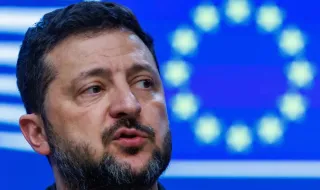
The European Union, Germany, France, the United Kingdom, Italy and Poland will represent Europe at the technical level in the next round of talks on ending the war in Ukraine. The European team is expected to consist of national security advisers, as well as representatives of the European Commission and the European Council, Bloomberg reported, citing a senior European official.
The decision was made following the meetings of European leaders in Dublin on 12 and 13 November. On Friday, European Council President António Costa confirmed that Europe would participate through five countries – the United Kingdom, France, Germany, Italy and Poland – together with the institutions of the European Union. According to him, the European team will work “in close coordination and full unity”.
Costa said: “There will be no discussion of Ukraine without Ukraine, and there will be no discussion of Europe without Europe.” He stressed that Europe’s security begins with Ukraine’s security.
Despite the European agreement, the specific date and location of the next round have not been announced. Russia has also not given its final approval for European representatives to sit at the negotiating table. Kremlin spokesman Dmitry Peskov said that Moscow would assess the matter based on Europe’s readiness to contribute to the peace process.
This means that the agreement reached in Dublin is a political decision by the European leaders, but the practical participation of the European team still depends on the format of future talks and on Russia’s position.
After a nine-month hiatus, Russia and Ukraine held a new round of talks in Abu Dhabi, mediated by the United States. Representatives of the United Kingdom, France, Germany, Italy, the European Union and NATO took part in separate coordination meetings, but were not part of the main format involving Moscow, Kyiv and Washington.
US representatives Steve Witkoff and Jared Kushner said after talks with Russian officials that the next round would be expanded to include European participation. Ukrainian President Volodymyr Zelensky also said that guarantees for Ukraine’s security and the future security architecture in Europe had been discussed during the meetings.
No breakthrough was achieved in Abu Dhabi on key issues, including territorial disputes. Russia and Ukraine did, however, report progress on individual matters, including a possible large-scale exchange of prisoners of war.
The European decision comes against the backdrop of limited direct contacts between European leaders and the Kremlin. On 27 October, Finnish President Alexander Stubb and Norwegian Prime Minister Jonas Gahr Støre spoke with Vladimir Putin from Helsinki for around 90 minutes. It was the first such direct conversation between European leaders supporting Ukraine and the Russian president since July 2025.