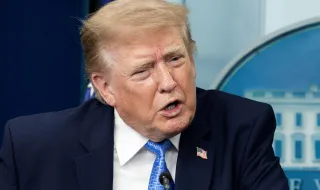
The Democrats’ victory in the US midterm elections opens the possibility of new pressure on Donald Trump’s administration over its policy toward Ukraine and Russia. The Democrats won control of the House of Representatives and the Senate, and the new Congress will begin work in January 2027.
Among the initiatives announced are the restoration of military aid to Kyiv, a package worth around $15 billion, new sanctions against Moscow and an investigation into the disruption of the Starlink service in Ukraine. The Democrats may also use congressional investigations to examine issues such as a possible easing of sanctions, the return of Russian diesel fuel to international markets and contacts between US representatives and the Kremlin.
The President Retains the Leading Role
“The short answer is: no,” Ukrainian diplomat Andrii Veselovskyi says when asked whether the loss of the Republican majority will change Trump’s approach to Ukraine and Europe.
According to him, US foreign policy, defense and security are determined above all by the president. Congress controls the budget and can block or limit individual decisions, but overcoming a presidential veto requires a two-thirds majority. Therefore, Veselovskyi believes that Democratic control of both chambers will increase political pressure, but will not give lawmakers the ability to unilaterally change the White House’s course.
Even before the new Congress takes office, Trump will have time to pursue his own plans for negotiations with Vladimir Putin. This creates a risk that decisions on the war and European security will be made during the transition period, before the Democrats receive their full powers of oversight and investigation.
Changes in the White House Reinforce the Hard Line
Following the Republicans’ electoral defeat, Trump replaced his chief of staff, Susie Wiles, with Stephen Miller. The appointment was seen as a signal of a more confrontational approach toward the new Democratic majority.
Veselovskyi assesses Miller’s influence as significant, including over the messages and decisions that reach the president. According to the diplomat, this does not mean that Trump is a puppet, but those around him may persuade him of certain scenarios and steer his political actions.
The diplomat places relations with Russia in a broader context. In his view, even a separate agreement on an energy truce or on Russian diesel, sanctions and the so-called shadow fleet would not change Vladimir Putin’s fundamental view of Ukraine.
The Pressure Could Be Targeted
“If Congress does manage to change something, it will be a lengthy process, and its influence will be targeted,” Veselovskyi says.
He warns that a possible deal between Washington and Moscow could affect not only the cessation of hostilities, but the entire security system in Europe. Meanwhile, Ukrainian President Volodymyr Zelensky said that the new European security framework being discussed by the US could be used by Moscow to weaken NATO and redraw the continent’s borders.
According to Veselovskyi, Ukraine is not among the main priorities of the current US strategy. The country is not a NATO member, while the European Union occupies a limited place in it. This leaves future US aid dependent simultaneously on decisions by the White House, Congress’s budgetary actions and the Democrats’ ability to turn their declared support into concrete legislation.
Sources: obozrevatel.com, investing.com, apnews.com