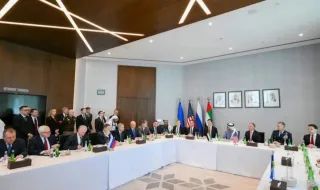
Europe was “at the children’s table” during the talks on Ukraine in Abu Dhabi. This was stated by Austrian Foreign Minister Beate Meinl-Reisinger in an interview with the German newspaper “Frankfurter Allgemeine Zeitung”.
“In Abu Dhabi, Europe sat at the children’s table. This is not the most glorious picture,” Meinl-Reisinger said. She called for the European negotiating team to urgently receive a common and specific mandate defining which positions it may defend on behalf of the European Union.
Europeans were outside the main talks
The latest round of trilateral talks between Russia, Ukraine and the United States was held in Abu Dhabi on November 10 and 11. European representatives were in the United Arab Emirates but did not participate directly in the discussions. The American and Ukrainian delegations held separate consultations with them, while the Russian side did not make contact with the European representatives.
According to the Austrian minister, European countries have demonstrated unity regarding support for Ukraine and sanctions against Russia, but have not taken the next step – declaring their readiness for direct diplomatic dialogue.
“We need both – firmness and dialogue. Now, at last, there is a negotiating team that must sit down at the table for the next round,” Meinl-Reisinger said.Four areas for the European position
Austria proposes dividing the negotiating work into four areas: politics, security, humanitarian issues and the economy. The political area should coordinate actions between the EU and NATO, the Organization for Security and Co-operation in Europe, the Council of Europe and the “coalition of the willing”.
In the field of security, Vienna is raising questions concerning a ceasefire, monitoring compliance with it and guarantees for Ukraine. The economic component should combine instruments of pressure with incentives for lasting peace and reconstruction.
Meinl-Reisinger also allowed for discussions on Russia’s security interests, but said that Europe would not allow Moscow to unilaterally determine the continent’s new security order. She proposed using the existing OSCE mechanisms to monitor a possible ceasefire.
The composition of the European team has already been determined
EU leaders agreed in Dublin on November 13 that the European team would include representatives of the Union’s institutions and of France, Germany, Italy, Poland and the United Kingdom. According to European Council President António Costa, the team should coordinate Europe’s participation and ensure a unified position in diplomatic efforts to end the war.
The Austrian minister described the participation of the five countries as justified by their military and political contributions, but stressed that the presence of the EU institutions was necessary to represent the entire Union, rather than individual capitals alone.
Kremlin spokesman Dmitry Peskov said that Moscow would not set conditions regarding the composition of the European group. According to him, however, the Russian side would assess the Europeans’ participation based on their actual intentions and willingness to contribute to the peace process.
Austria’s proposal is to be presented at the meeting of EU foreign ministers. European leaders will further discuss the Union’s role in the negotiations at their meeting on November 26 and 27.
Sources: euronews.com