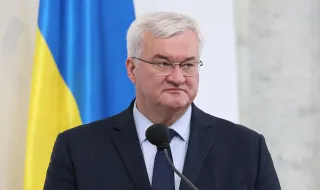
Russia is repeating the ultimatum that preceded its invasions of Georgia and Ukraine, Ukrainian Foreign Minister Andrii Sybiha said. He described Moscow’s demands for a new „European security architecture“ as an old ultimatum presented under a new name.
„This is not an invitation to dialogue. History shows what follows: a new escalation of military action by Russia in aggressive forms, including open armed aggression,“ Sybiha said.
The parallel with Georgia and Ukraine
The Ukrainian minister recalled that in 2007, Vladimir Putin described NATO enlargement as a threat during the Munich Security Conference. In 2008, the Kremlin issued threats over the prospect of Georgia and Ukraine joining the Alliance. Several months later, Russia invaded Georgia.
Sybiha also drew a parallel with the end of 2021, when Moscow demanded an end to NATO enlargement and the return of the Alliance’s military infrastructure to its positions as of 1997. In February 2022, Russia launched its full-scale invasion of Ukraine.
What the new Russian demands are
According to The Washington Post, during the talks in Abu Dhabi, Russia once again demanded that NATO withdraw its forces and bases to the level of 1997. This would affect countries that joined the Alliance after that year, including Poland, Hungary, the Czech Republic and the Baltic states.
The Russian proposals also include an end to further NATO enlargement, restrictions on the Alliance’s military activity in Eastern Europe, the South Caucasus and Central Asia, as well as a ban on Ukraine becoming a NATO member. The document also contains restrictions on the size and armament of the Ukrainian army, a halt to Western arms deliveries, and a ban on deploying foreign troops and military facilities on Ukrainian territory.
Sybiha called on the West, instead of complying with Russian rules, to increase pressure on Vladimir Putin’s regime and force it to take peace efforts seriously. According to him, ending Russian aggression against Ukraine must be placed at the center of the negotiations, rather than revising the European security system.
Sources: eurointegration.com.ua, interfax.com.ua, washingtonpost.com