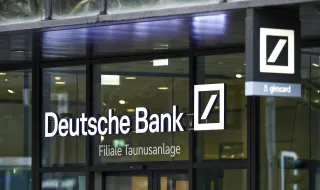
Deutsche Bank transferred wealthy Russian clients to its divisions in Switzerland and Luxembourg before the start of the full-scale war in Ukraine. This limited the ability of the US Department of Justice to obtain complete information about some sanctioned businesspeople, according to an international journalistic investigation based on leaked internal bank documents.
Following the wave of sanctions in 2014, US authorities began asking Deutsche Bank questions about its Russian clients and their businesses. According to the documents, in 2018 the bank began transferring major clients linked to Russia to be serviced in Switzerland and Luxembourg. An earlier internal strategy had also discussed concentrating the Russian client business in jurisdictions that protect banking secrecy.
17 clients accounted for 47% of revenue
In November 2020, Deutsche Bank prepared a 172-page “Review of the Russia Strategy.” It listed 160 major Russian clients, 17 of whom appeared on the US Treasury Department’s “Kremlin List.” These 17 individuals generated 47% of the bank’s revenue from its Russian client portfolio.
By November 2021, at least 46 clients had been internally classified as “highly sensitive” because of heightened reputational and sanctions risks. The names mentioned in the investigation include Oleg Deripaska, Roman Abramovich, Andrey Melnichenko, Alisher Usmanov, Alexey Mordashov and Gennady Timchenko.
As early as 2014, an internal Deutsche Bank committee had prepared a ranking of clients according to the potential threat they posed to the bank’s reputation. Deripaska was placed at the top.
US authorities received incomplete information
In 2021, Deutsche Bank entered into an agreement with the US Department of Justice that allowed American prosecutors to request information about sanctioned individuals and companies. After the start of Russia’s invasion of Ukraine in 2022, they requested the names of sanctioned Russian clients, information about their accounts and balances, as well as details about control over the movement of Russian funds.
The bank handed over some of the data but refused to provide certain information about clients serviced by its divisions in Switzerland and Luxembourg. An internal Deutsche Bank representative wrote to the US Department of Justice:
“Certain client data is not provided because of local restrictions in the area of banking secrecy.”
In its response, the bank also did not include companies owned by sanctioned businesspeople with a stake of less than 50%. According to the investigation, this probably limited the disclosure of information about some of Deripaska’s assets.
Deutsche Bank denies seeking ways to help clients circumvent sanctions. The bank says that concentrating Russian clients in specialized centers such as Switzerland and Luxembourg was “part of its operating model in the area of wealth management,” and that clients underwent the necessary checks and enhanced scrutiny.
Withdrawal from Russia and new legal risks
In March 2022, Deutsche Bank announced that it was ending new business in Russia and beginning a full withdrawal from the country. Nevertheless, in 2024 the Arbitration Court of St. Petersburg and the Leningrad Region froze the bank’s assets worth approximately €239 million in a lawsuit brought by RusHimAlliance.
At the beginning of 2026, German investigators searched Deutsche Bank’s headquarters. According to the investigation, the search was linked to transfers made for the benefit of Roman Abramovich, allegedly carried out days before the start of Russia’s invasion. Abramovich’s legal representatives denied the allegations and said that neither the German authorities nor the bank had named him as a suspect.
Deutsche Bank also said that it had notified Germany’s central bank of possible violations of the European Union’s sanctions against Russia. The bank claims that it fulfilled its obligations to US authorities and invested €7 billion between 2019 and 2025 in its control and regulatory compliance systems.
Sources: meduza.io, storage.googleapis.com, dw.com