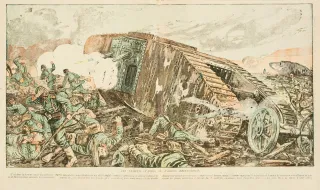
At 6:20 a.m. on November 20, 1917, near the French town of Cambrai, British tanks moved forward against the German Hindenburg Line. This was the first operation in which tanks were used en masse as the main striking force. The offensive by the British Third Army involved six infantry and two cavalry divisions, more than 1,000 guns, and 476 tanks.
The initial attack was directed against German defenses in which the 20th Landwehr and 54th Reserve Divisions, as well as units of the 9th Reserve Division, played the main role. The British relied on surprise, a brief artillery preparation, and the coordinated action of infantry, tanks, artillery, and aviation. Such coordination would later become the foundation of modern combined operations.
476 tanks against the Hindenburg Line
Of all the vehicles, 378 were battle tanks, while the rest were intended for supply, communications, and other support tasks. According to the Australian War Memorial, the attack tore a gap approximately 10 kilometers wide in the German front and advanced roughly 6 kilometers. For the first time, tanks were not distributed in small groups among infantry units, but were used on a scale that enabled them to determine the course of an entire operation.
The success, however, did not turn into a decisive breakthrough. Some of the tanks broke down, while others became bogged down or were destroyed by artillery. The German 54th Reserve Division had already trained its artillerymen to fire at moving targets, and German reserves began arriving at the front. The National Army Museum in London notes that Cambrai demonstrated the potential of tanks, but also the problems with their reliability, supply, and cooperation with infantry.
“We heard strange pulsating noises, and slowly three enormous mechanical monsters, such as we had never seen before, approached us,” Private Bert Chaney recalled of the tanks’ first appearance on the front in 1916.The German counteroffensive
On November 30, the German Army launched a large-scale counteroffensive with around 20 divisions. The pressure forced the British to abandon much of the territory they had captured in the first days. According to the Australian War Memorial, by December 7 the Germans had retaken all the territory lost in the initial attack, while total casualties amounted to approximately 45,000 British and 50,000 German dead and wounded.
For this reason, Cambrai was not a decisive British victory, but it changed the understanding of the role of tanks. The battle showed that armored vehicles could break through a fortified position when operating in large groups and supported by infantry and artillery. It also demonstrated the opposite: without reserves, supplies, and the ability to maintain momentum, even a successful breakthrough could be lost.
“Little Willie” did not take part in the first battle
The widespread claim that the first British tank, “Little Willie,” received its baptism of fire at Flers on September 15, 1916, is inaccurate. “Little Willie” was a prototype developed during the early trials of British tracked vehicles. In the first battle at Flers-Courcelette, the British Army used Mark I tanks.
Forty-nine tanks were sent to the Somme, but only 15 managed to move forward by the start of the attack. The vehicles succeeded in crossing the wire entanglements and produced a powerful psychological effect, but they did not achieve a breakthrough. It was precisely this limited experience that led to the search for a larger scale and better coordination, which received their first major test at Cambrai.
Sources: history.com, forcesnews.com