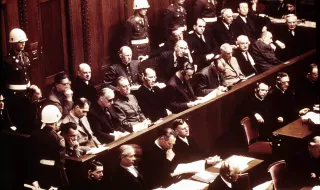
In Courtroom 600 of the Palace of Justice in Nuremberg, the first international trial against senior representatives of a state for crimes committed during wartime begins on November 20, 1945. The International Military Tribunal, established by the United States, the United Kingdom, France and the Soviet Union, brings the leaders of Nazi Germany to trial.
The indictment against 24 people was submitted a month earlier in Berlin. It included four main categories of charges: a common plan or conspiracy, crimes against peace, war crimes and crimes against humanity. They covered the planning and waging of wars of aggression, violations of international treaties, crimes against prisoners of war and civilians, as well as the persecution and mass extermination of populations.
The Case Against 24 Defendants
The defendants included Hermann Göring, Rudolf Hess, Joachim von Ribbentrop, Wilhelm Keitel, Alfred Rosenberg and Albert Speer. Not all 24 defendants appeared physically before the tribunal. Robert Ley committed suicide in prison on October 25, 1945. Gustav Krupp von Bohlen und Halbach was declared medically unfit to stand trial, while Martin Bormann was tried in absentia because he had not been found by the Allies.
The trial continued until October 1, 1946. A total of 403 public hearings were held. According to data from the Nuremberg Trials Memorial, 236 witnesses were heard, around 200,000 written affidavits were used and 5,330 documents were presented. Some of the evidence consisted of documents created by the structures of the Nazi regime itself.
“The privilege of opening the first trial in history for crimes against peace carries an enormous responsibility,” chief American prosecutor Robert Jackson declared at the beginning of the trial.The Verdicts and Consequences
The verdicts were delivered on September 30 and October 1, 1946. Twelve defendants were sentenced to death by hanging, three received life imprisonment, and four were sentenced to prison terms of varying lengths. Two received 20 years, one – 15 years, and one – 10 years. Three were acquitted.
The death sentences were carried out on October 16, 1946, but not all those sentenced were executed. Hermann Göring committed suicide with cyanide in prison shortly before the sentence was to be carried out, while the sentence against Bormann was handed down in absentia.
The Nuremberg Trial established the principle that personal responsibility is not eliminated by holding high public office or by following a superior’s orders. The tribunal’s decisions laid the foundation for the development of international criminal law and for later trials against perpetrators of war crimes and crimes against humanity.
Sources: theguardian.com, lemonde.fr