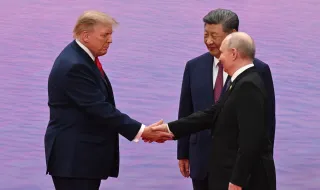
Vladimir Putin and Xi Jinping held bilateral talks in Shenzhen ahead of the trilateral meeting with U.S. President Donald Trump scheduled for November 19. The talks addressed the development of Russian-Chinese relations, strategic cooperation, and the international and regional agenda. The Russian delegation included Foreign Minister Sergey Lavrov, Finance Minister Anton Siluanov, and Putin’s aide Yuri Ushakov.
This is the third in-person meeting between Xi and Putin since the beginning of 2026 and their 50th meeting since 2013, including talks held via video link. The following day, the forum of the Asia-Pacific Economic Cooperation will be held in the Chinese technology hub, with a meeting between the leaders of the United States, China and Russia planned as part of the event.
Nuclear weapons are among the main topics
Ukraine may be addressed, but according to a publication by “Fokus”, it is not Washington’s main concern. The Kremlin said that Putin and Trump would discuss the war and the results of the recent peace talks in Abu Dhabi. The U.S. side, however, is focusing on a possible agreement on strategic nuclear weapons, as well as on Iran and North Korea. The previous treaty between the United States and Russia in this area expired at the end of the winter of 2026.
Economic issues are also expected to be added to the agenda, including technology and chip manufacturing. Separately from the trilateral meeting, Trump will also hold bilateral talks with Putin. This will be their first separate meeting since their talks in Alaska in 2025.
Beijing has influence over Moscow, but does not use it
According to China expert Yuri Poita, the bilateral talks between Xi and Putin are part of regular diplomatic coordination between Moscow and Beijing. This covers relations with the United States and Europe, as well as the war in Ukraine.
“China potentially has such opportunities, but so far it has not used them,” Poita said.According to him, the Russian economy depends on the Chinese market for up to 40 percent, while Russia’s military industry is linked to supplies from China. Beijing also has diplomatic influence over Moscow, but the expert does not expect the Chinese leadership to use it to force the Kremlin into making serious concessions in the negotiations.
Poita believes that China may benefit either from the continuation of the Russian war or from its termination on terms close to Russia’s. According to him, the ongoing conflict ties up U.S. and European resources that could otherwise be directed toward countering China in Asia.
Why “Yalta 2” does not seem realistic
Political scientist Igor Reiterovich believes that the meeting is important for all three leaders, but for different reasons. Xi Jinping has an interest in presenting China as the host country and a center of international diplomacy. Trump may use the format for talks on nuclear weapons, the Middle East, the economy and technology. For Putin, participation is an opportunity to demonstrate that Russia is not isolated.
Reiterovich rejects comparisons with the 1945 Yalta Conference because the three countries today have no common opponent and defend different interests. According to him, Moscow would like to present the meeting as a sign of equal standing, but the format does not automatically mean a joint decision on Ukraine or a new division of spheres of influence.
Sources: focus.ua, apnews.com