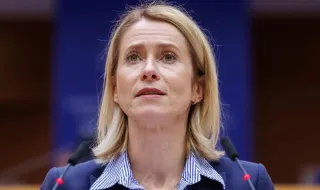
Kaja Kallas has been excluded from the European delegation for future talks on resolving the conflict in Ukraine. According to The Guardian, the decision is linked to her hard-line stance towards Russia, the reluctance of the European Union’s major powers to hand over foreign-policy influence to Brussels, and the strengthening role of national leaders in international diplomacy.
The format of European participation was approved on 13 November during a summit in Dublin. The team includes European Council President António Costa, European Commission President Ursula von der Leyen, and representatives of France, Germany, the United Kingdom, Poland and Italy. They are expected to work with US representatives Steve Witkoff and Jared Kushner, as well as with NATO.
Three reasons for the decision
The first reason cited by the British publication is the attitude of several Western European capitals towards Kallas. According to the report, they consider her too uncompromising towards Moscow. The second is related to the position of France and Germany, which prefer to retain their own representation in the talks rather than hand the leading role to a single EU representative.
The third factor is a broader change in international diplomacy. Issues traditionally discussed by foreign ministers are increasingly being taken up by presidents and prime ministers, The Guardian notes.
Kallas challenged the chosen format
Kallas expressed her disagreement with the decision. She said that, as the EU’s High Representative for Foreign Affairs and Security Policy, she should be the one to represent the union in the talks.
Von der Leyen defended the choice made by the European leaders:
“We decide ourselves who will represent us, and we made that decision today.”German Chancellor Friedrich Merz also supported the intergovernmental format and described it as established practice.
Spain and Lithuania, however, criticised the approach. Lithuanian Foreign Minister Kęstutis Budrys said:
“Europe must speak with one voice. We cannot speak with 27 microphones.”The dispute highlights the gap between the EU’s ambition to act as an independent geopolitical actor and the reluctance of individual countries to transfer real powers to the common institutions.
From the Kremlin, Dmitry Peskov said that any potential dialogue with the EU would depend on the genuine intentions of the European countries and their readiness to contribute to the peace process. According to him, Vladimir Putin has not abandoned contacts with European leaders.
Sources: rbc.ru, theguardian.com