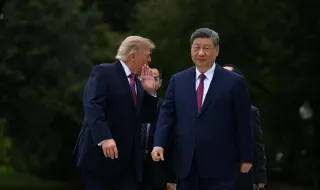
China is expanding its nuclear arsenal at a very rapid pace and could catch up with the United States within 10 years, President Donald Trump said at a press conference at the White House. “They will catch up with us within 10 years. They are developing it at a very rapid pace, but they have a lot of weapons,” he said.
Trump’s assessment came a day after his meeting with Chinese President Xi Jinping and Russian President Vladimir Putin in Shenzhen. It was the first trilateral meeting between the leaders of the United States, China and Russia. The talks lasted about 90 minutes.
Dialogue on nuclear risks
After the meeting, the three countries said they would begin a dialogue on reducing nuclear risks and preventing the proliferation of nuclear weapons. In their joint statement, the leaders wrote that “a nuclear war cannot be won and must never be fought”.
Secretary of State Marco Rubio defended the need for talks between Washington, Beijing and Moscow. “These three countries possess the overwhelming majority of the world’s nuclear weapons. The idea that their leaders should not speak regularly is not merely absurd, but dangerous,” Rubio said.
According to The Associated Press, the agreement sets out a common direction but contains no specific commitments regarding the number of warheads, their production or inspections of nuclear facilities.
China’s arsenal is growing
In its annual review of China’s military power, the Pentagon says that by 2024 China had just over 600 nuclear warheads. The US military estimates that the number could exceed 1,000 by 2030.
The United States and Russia each possess several thousand nuclear weapons, putting China’s arsenal at a significantly lower level. Beijing is, however, expanding the infrastructure associated with its nuclear forces and developing new capabilities for delivering nuclear warheads.
China’s Foreign Ministry maintains a different position. In July, spokesperson Mao Ning said that the country was keeping its nuclear capabilities at the minimum level necessary for national security and was “not participating in any form of nuclear arms race”.
Erin Dumbacher of the Council on Foreign Relations described the agreed dialogue as a positive sign, but stressed that it does not yet represent a genuine nuclear arms control agreement. The next talks will have to show whether the joint political statement will lead to concrete measures to limit the risk.
Sources: apnews.com, washingtonpost.com, scrippsnews.com