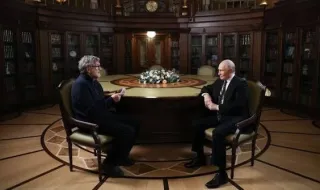
Russia is not simply a state, but a distinct civilization whose historical mission is linked to preserving Orthodoxy and traditional values. This is one of the main theses Vladimir Putin develops in a conversation with Serbian director Emir Kusturica. The interview is part of a documentary about Patriarch Kirill of Moscow and All Rus, dedicated to his 80th anniversary.
Although the reason for the conversation is religious, its content goes far beyond church affairs. In it, Putin presents a kind of political and historical doctrine concerning Russia’s place in the world, its relations with the West and the conflict with Ukraine. Particular attention is drawn to the way the Russian president links Orthodox faith, national identity and statehood.
“Moscow is the Third Rome, and there will be no fourth”
One of the most significant moments in the conversation is Putin’s reference to the historical concept of Moscow as the Third Rome.
“Moscow is the Third Rome, and there will be no fourth,” the Russian president says, explaining that Russia is the heir to the spiritual tradition of Rome and Byzantium.
This idea has deep historical roots. It is associated with a letter written by the monk Philotheus of Pskov at the beginning of the 16th century, in which Moscow is presented as the heir to the Orthodox imperial tradition following the fall of Constantinople in 1453.
In political terms, the concept acquires particular significance because it places Russia not simply among the other states, but in the role of a civilizational center with its own historical mission.
Putin defines the Russian Orthodox Church as the spiritual guardian of this legacy. In his words, Russia could be a kind of “ark” preserving Christian values and offering refuge to people who want to defend them.
This message also has a clear international-political dimension. It presents Russia as an alternative to the Western social model, which, according to Putin, is gradually moving away from traditional Christian principles.
Orthodoxy as part of the state strategy
Putin’s position on relations between the Russian state and the Church is particularly interesting.
He describes his relationship with Patriarch Kirill as being based on genuine friendship and emphasizes that the connection between the state and Orthodoxy is historical in nature.
The Russian president refers to the Russian Empire, when the ruler was regarded as the defender and patron of the Church, but not as its direct spiritual head.
Here Putin also recalls a little-known historical detail – the role of the Holy Synod, which in imperial Russia was the highest body of church administration. Its ober-prosecutor was a secular official who represented state authority in relations with the Church.
This historical reference is important because it shows that the Russian president views cooperation between the state and the Church not as a temporary political construct, but as a continuation of a centuries-old tradition.
Putin also recalls Stalin’s 1943 decision to restore the patriarchate in the USSR. This took place during the Second World War, following the heavy military clashes at Stalingrad and Kursk.
The paradox is that it was precisely the Soviet leader, under whose rule large-scale repressions against religious institutions were carried out, who restored the patriarchal institution at a time when the state was seeking additional public and spiritual mobilization.
Putin uses this historical example to emphasize his thesis that the Russian Orthodox Church remained close to the people even during the most difficult periods in history.
Ukraine – the political message behind the religious conversation
The most direct political element in the interview appears when Kusturica steers the conversation toward the war in Ukraine.
The director recalls Putin’s position that Russians and Ukrainians are one people, and asks him what message he would send to Ukrainians and why, in his view, Russia’s victory would be in their interest.
The Russian president’s response follows the thesis he has repeatedly expressed about the historical and cultural unity between the two peoples.
Putin calls on Ukrainians to take “our side,” which he describes as the right side of history. At the same time, he clarifies that he is not necessarily speaking of unification into a single state, but of broader unity around common goals.
This clarification is significant. It leaves open the question of what exactly the Russian president means by political unification, but clearly shows that Moscow continues to view its relations with Ukraine through the prism of a shared historical and civilizational identity.
Putin accuses Western countries of supporting Ukraine not because of the interests of the Ukrainian people, but in order to weaken Russia, divide it and place it under control.
This is a central part of Russia’s official interpretation of the conflict. It presents the war not only as a clash between Moscow and Kyiv, but also as a broader confrontation between Russia and Western countries.
It is important to note that these are Putin’s claims and political assessment, not independently established facts. Ukraine is a sovereign state, and Russia’s full-scale invasion began in February 2022.
“Not the speed of the missiles, but the speed of thought”
In one of the most interesting moments, Kusturica asks whether the outcome of the war will be determined by the speed of missiles or by the spiritual strength of the Russian people.
Putin’s response is indicative of the way he presents the modern military conflict.
“Today, what matters most is not the speed of the missiles, but the speed of thought,” the Russian president says.
He explains that military technology is developing so rapidly that mathematical knowledge, the ability to react quickly and adaptation to new challenges are now of decisive importance.
Thus, the conversation moves from religious symbolism to the technological and military dimensions of the conflict. Putin effectively emphasizes scientific and technological potential as a factor in strategic superiority.
At the same time, he does not abandon the idea of spiritual strength as the foundation of Russian society.
Putin’s personal story linking him to Patriarch Kirill
One of the most unexpected moments in the conversation is the Russian president’s account of his own baptism.
Putin reveals that he was baptized by the father of the current Patriarch Kirill – the priest Mikhail Gundyaev.
He says that he was an ordinary boy from a working-class family, while the man who performed his baptism was the father of the future head of the Russian Orthodox Church.
The story contains another interesting detail: the future Patriarch Kirill left home at the age of 15 to begin an independent life. He initially turned to geology, studied cartography and took part in a geological expedition before embarking on a church career.
Putin describes the life connection between the two as a kind of miracle – the priest’s son became a patriarch, while the boy he baptized later became president of Russia.
This personal story also serves a political function in the context of the interview. It presents the closeness between the president and the patriarch not only as an institutional partnership, but also as a relationship rooted in a long-standing personal and family history.
Russia versus the West – a clash of values
Another important theme in the conversation is the comparison between Russian society and Western countries.
Putin claims that Western Christian churches are losing influence because they are moving away from their traditional canons and attempting to adapt religious teaching to contemporary public attitudes.
According to him, Orthodoxy attracts people precisely because it preserves traditional principles.
Kusturica adds to the conversation by claiming that over the past five years, 1.5 million people in North America have converted to Orthodoxy. However, this figure is not supported by a specific source in the interview and should not be accepted as independently verified statistics.
Putin presents Russia as a state in which Orthodoxy, Islam, Judaism and Buddhism can coexist within a common civilizational identity.
Here another of his theses emerges – that Russian civilization has the ability to integrate different peoples without necessarily erasing their languages, religions and traditions.
This is an important element of Russia’s concept of a multipolar world, in which different civilizations should preserve their own identities and not be subordinated to a single universal model.