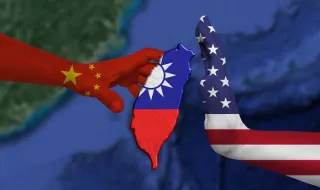
An American expert said on Thursday that it was unlikely that U.S. President Donald Trump and Chinese President Xi Jinping had reached an agreement on Taiwan during their latest summit at the Asia-Pacific Economic Cooperation (APEC) meeting in China.
The APEC leaders’ meeting was held in Shenzhen on November 18 and 19.
“The Taiwan issue was probably raised during the meeting, and I do not think the two leaders reached any agreement,” said Zack Cooper, a senior fellow at the American Enterprise Institute specializing in U.S. strategy in Asia.
U.S. arms sales to Taiwan
The Shenzhen meeting was the third between Trump and Xi this year, following summits in Beijing in May and Washington in September. Xi is expected to visit Florida in December for the Group of Twenty (G20) summit, which will be hosted by Trump.
Regarding the proposed $14 billion package for the sale of U.S. weapons to Taiwan, which is still awaiting approval from the Trump administration, Cooper said he did not expect an announcement on the issue for at least another month, and that it could come after the G20 summit.
“But this is probably the most important issue to watch right now,” he said.
After attending the APEC summit on Thursday, Trump met with Xi for about an hour at Qilin Villa. He then joined Xi and Russian President Vladimir Putin for a trilateral meeting before departing for Washington.
Cooper said the trilateral meeting between Trump, Xi and Putin had produced only a brief statement repeating remarks the leaders had made previously.
According to him, the statement did not mean that any real agreement had been reached among the three leaders.
U.S. considers tighter restrictions on chip exports to China
“Relations between the United States and China are becoming increasingly complicated,” Cooper said.
He said the United States would likely impose additional restrictions on exports of advanced semiconductors to China – a measure that would affect Taiwan but have a more serious impact on China.
Cooper expects tensions between Washington and Beijing to intensify over the next few months, adding that it remains to be seen what the consequences for Taiwan will be.
Asked whether the controversies surrounding Nvidia founder Jensen Huang could have influenced the meeting between Trump and Xi, particularly the discussions on U.S. restrictions on chip exports to China, Cooper said he did not believe they had had a significant impact on the meeting. He said, however, that the case could have significant consequences for future bilateral negotiations and the development of U.S.-China relations over the next one or two years.
“This is less about Jensen Huang than about the business decisions Nvidia is making,” he said.
The controversies arose amid U.S. national security concerns related to reports of Huang’s extramarital affairs, including with a woman suspected of spying for China. She had previously worked for Megaspeed – a Singapore-based Nvidia client that is under investigation in the United States over suspicions that it allegedly redirected restricted artificial intelligence chips to China.
Cooper said the issue of Huang’s relationship with the woman suspected of spying had long been an open secret in Washington, but until recently there had not been sufficient bipartisan support for taking action. Now, however, both Republicans and Democrats are asking why the Trump administration allowed this to happen.
According to him, over the coming months the U.S. Congress will likely pass a series of bills to restrict and regulate exports related to chip manufacturing, which will determine the direction of technological relations between the United States and China in the years ahead.