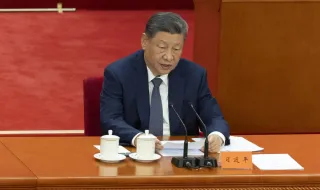
On November 29, 2012, Xi Jinping officially formulates the concept of the “Chinese Dream” for the first time – a political vision that later becomes one of the main slogans of his administration. This takes place during a visit to the National Museum of China in Beijing, just two weeks after his election as general secretary of the Communist Party of China.
Xi Jinping and other party leaders tour the “Road to Rejuvenation” exhibition, dedicated to the history of the Chinese nation from the beginning of the modern era to the country’s contemporary development. The exhibition presents the loss of Chinese sovereignty in the 19th century, the struggles for national independence and China’s rise following the establishment of the People’s Republic.
“The rejuvenation of the Chinese nation is the greatest dream of the Chinese people since the beginning of the modern era,” Xi Jinping declares.In English-language publications, the expression is established as Chinese Dream, while in Chinese political discourse it is most closely associated with the “great rejuvenation of the Chinese nation.” According to the Chinese news agency Xinhua, Xi Jinping first used the concept publicly precisely on November 29, 2012.
A vision for China through the middle of the century
In his speech, Xi places the “Chinese Dream” within the framework of two long-term goals. The first is linked to the centenary of the Communist Party of China in 2021 and envisages building a moderately prosperous society. The second is aimed at 2049 – the centenary of the founding of the People’s Republic of China – when the country is to become a modern socialist state that is prosperous, strong, democratic, culturally advanced and harmonious.
Thus, the concept is not presented solely as a national symbol. It encompasses economic development, the strengthening of the state, the restoration of China’s international influence and the pursuit of a better life for the population. Subsequently, the Chinese authorities begin using the expression in official speeches, party documents, educational campaigns and public messaging.
From slogan to a central political concept
On March 17, 2013, after being elected president of the People’s Republic of China, Xi Jinping develops the idea in a speech to the National People’s Congress. At that point, the “Chinese Dream” is linked even more directly to three elements – national prosperity, national rejuvenation and the happiness of the people.
Over the following years, the formulation becomes the political center of the “Xi Jinping” era. Domestically, it serves as a unifying narrative for China’s development, while in foreign policy it is presented as an aspiration for a stronger, modern and influential state. Its first public use in November 2012 marks the beginning of a concept that gradually permeates every level of official Chinese political discourse.
Sources: xinhuanet.com, theguardian.com