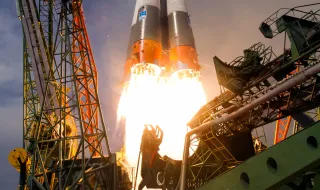
Russia could launch a satellite carrying a nuclear warhead into space by the end of the year, Western intelligence services claim, according to a joint investigation by WDR, NDR and „Süddeutsche Zeitung“. The German government said it takes the information „very seriously“, but stressed that there is currently no immediate threat.
The satellite has been designated as „Sputnik-S“. According to the reports, it was designed several years ago and is located in the Moscow area. Warnings circulated among several NATO countries at the beginning of November indicate that the spacecraft could be launched within 60 days. The German Space Command believes this could happen as early as December.
Merz: This is shocking
Chancellor Friedrich Merz described the reports as shocking during a joint press conference with NATO Secretary General Mark Rutte in Berlin.
Government spokesperson Stefan Kornelius said that the information was being taken seriously, but urged people not to create „excessive nervousness“ over hypothetical scenarios. According to him, there is no immediate danger. Kornelius confirmed that the National Security Council had discussed the changed situation in space on November 3, but the content of the meeting is classified.
Moscow rejects the claims
The Kremlin rejected the reports. Spokesperson Dmitry Peskov said that the claims were based on numerous unconfirmed assumptions and did not deserve serious attention. The Russian Embassy in Berlin called the information „unfounded accusations“ and a „propaganda campaign“, stating that Russia’s space activities are carried out in accordance with its international obligations and have exclusively peaceful purposes.
Germany’s Foreign Ministry warned that deploying a nuclear weapon in orbit would constitute an obvious violation of the 1967 Outer Space Treaty. The document prohibits placing into orbit objects carrying nuclear weapons or other weapons of mass destruction.
A threat to satellites
According to assessments cited by German media, such a system would primarily be intended to destroy or disable satellites, rather than to attack the population of Earth. A nuclear explosion in space, however, could damage a large number of spacecraft and affect communications, navigation, military systems and some of the infrastructure that depends on satellite services.
NATO continues to assess the risk. Mark Rutte said that the Alliance would defend every inch of its territory, including against threats originating in space.
Sources: ndr.de, sueddeutsche.de, theguardian.com