Ukrainian strikes on Russian ships and a helicopter off the coast of Libya, confirmed yesterday by Ukrainian President Volodymyr Zelensky, are among the main topics in the Western press.
United Kingdom
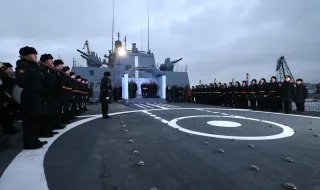
British newspaper "The Independent" estimates the value of the Russian warship—the "Mercury" corvette of the Russian Navy—blown up by Ukrainian forces near the port of the Libyan city of Benghazi at £150 million. The Tripoli-based Libyan government—one of the two governments in the country—warns that the national territory "is becoming an arena for settling scores," the newspaper adds.
"Kremlin reacts after Kyiv blows up Putin warship worth £150m docked in Libya," reads the headline of the article in "The Independent" by Myra Butt and James Kay Reynolds. The authors point out that Moscow has threatened Kyiv with "painful consequences" following devastating Ukrainian strikes on two Russian vessels. The other was identified as the cargo ship "Angara" (MV Angara), which, according to Zelensky, was used to transport weapons. According to information released by the Ukrainian president, a Russian K-27 helicopter was also destroyed alongside the corvette.
"The Independent" quotes Kremlin spokesman Dmitry Peskov as saying yesterday that these Ukrainian actions would lead to "extremely painful consequences for the regime in Kyiv.“ "I would like to recall President Putin's statement in Shenzhen, in which he confirmed that the approach applied so far in the actions of our military will remain unchanged,“ he said.
At the same time, Zelensky said that Ukraine was continuing its operations in certain maritime areas. The attack came just one day after a drone strike on a cargo ship linked to the Russian military in the Gulf of Finland, "The Independent" notes.
As for Ukraine's military capacity, another British newspaper—"The Financial Times"—reports today that US Defense Secretary Pete Hegseth has still not approved the delivery of 60 interceptor missiles already earmarked for Ukraine's "Patriot“ air defense systems.
According to sources cited by the British newspaper, these are American PAC-2 and PAC-3 missiles (PAC-3 and PAC-2/Patriot Advanced Capability—"Advanced Capabilities of Patriot“), some of which are held in European arsenals and financed by Kyiv's Western allies. Among the missiles whose transfer has still not been approved are PAC-3 interceptors, deliveries of which had been planned for the period from September to December this year, "The Financial Times" specifies. According to the newspaper, none of these deliveries has yet received authorization.
The British newspaper also reports that the Pentagon is delaying another matter—granting Ukraine permission to independently produce interceptor missiles for "Patriot“ systems. A US Department of Defense spokesman tells the newspaper that there has been no change in American policy regarding support for Ukraine, but declines to comment specifically on the weapons issue.
Meanwhile, "The Guardian" highlights another aspect of the war in Ukraine—Russia's battlefield losses. Under the headline "Russian war casualties: the hidden cost of the conflict in Ukraine," the British newspaper offers a detailed analysis according to which Russia has suffered nearly 500,000 casualties since it invaded the neighboring country in February 2022. According to the British publication, leaked confidential data reveal more than 1,000 suicides among Russian military personnel during the war, which is entering its fifth year.
According to "The Guardian," the "black" statistics are shocking—the Russian army is now losing 720 people every 24 hours, the highest rate of losses since the beginning of the war. At least one-third of the service members are killed in the Pokrovsk area, where Moscow sent tens of thousands of troops in a spring offensive. The figures come from a database containing 11 million death certificates accessed by the Belarusian opposition-linked hacker group "Cyber Partisans“ (Cyber Partisans) and the Ukrainian hacking collective "Silent Crow," the UK newspaper reports.
"The Guardian" identifies more than 460,000 war-related deaths between the invasion that began on February 24, 2022, and September this year. Last year, the war became the leading cause of death among Russian men under the age of 65, the newspaper reports. "There has always been one unknown X factor: how many Russian casualties remain unreported? It turned out that the number is much, much higher than we assume,“ Dr. Janis Kluge, a Russia expert at the German Institute for International and Security Affairs who closely monitors Russia's losses on the front in Ukraine, told the British newspaper.
Normally, in military conflicts, there are around three wounded soldiers for every one killed. Kluge, however, notes that according to data on the war in Ukraine, the number of Russian soldiers killed may exceed the number of seriously wounded. "This says a great deal both about the war itself and about the way it is being waged,“ he notes.
Despite all these losses, the front line has barely changed, "The Guardian" notes. According to data from the Ukrainian monitoring group "Deep State" (DeepState), since the beginning of 2023 Russia has seized around 8,000 square kilometers—less than 1.5% of Ukraine's territory.
"The Guardian" offers another focus regarding the conflict—the European Commission's latest attempt to increase pressure on Russia. The British daily's Brussels correspondent, Jennifer Rankin, reports that the proposed 22nd package of sanctions "against the Kremlin's war machine," put forward by European Commission President Ursula von der Leyen, comes after a period of doubts about the EU's ability to impose new, significant sanctions on Moscow. Von der Leyen has again put forward a proposal to ban Russian military personnel from entering EU territory, the author writes in "The Guardian." This is part of a package of restrictions affecting Russia's banking sector, energy industry and sport.
A few months ago, it was uncertain whether the 22nd package of sanctions would contain anything substantial at all, Rankin points out. She recalls that during the difficult negotiations over the 21st package in July, one existing sanction—concerning the transport of liquefied natural gas—was softened, while EU member states postponed a plan to ban access to the bloc for people who had served in the Russian army—a move that faced opposition from France and Italy, two countries that had issued large numbers of tourist visas.
In addition, in September two Russian oligarchs—Alisher Usmanov and Mikhail Fridman—were removed from the EU sanctions list. In the same month, Ursula von der Leyen said that the EU should focus on closing loopholes in the sanctions regime, Jennifer Rankin notes, quoting the Commission president's State of the Union address: "What is needed is not necessarily new sanctions, but above all the implementation of those already in place“.
Since then, however, Russia has intensified its bombardment of Ukraine, while aggressive actions have also been carried out on EU territory, including a series of deadly drone strikes in the Black Sea, "The Guardian" notes.
Germany
Another reason to focus attention on Russia's escalating aggression is a joint investigation by German newspaper "Süddeutsche Zeitung" and German public radio and television channels Westdeutscher Rundfunk (WDR) and Norddeutscher Rundfunk (NDR), part of the state broadcaster ARD network. According to the investigation, Russia is planning to deploy nuclear weapons in space.
According to the newspaper and the two broadcasters' investigation, Western intelligence agencies believe that Moscow intends to launch a satellite carrying a nuclear warhead into space this year. According to "Süddeutsche Zeitung," the German military—the Bundeswehr—is already "raising the alarm" in Berlin.
This is a scenario that military officials, intelligence officers and politicians have been warning about for several years—namely, the detonation of an atomic bomb in space, the German newspaper writes, adding that it could damage or destroy numerous satellites and would probably have devastating consequences for Earth.
"Süddeutsche Zeitung" recalls that in February 2023, when one year had passed since the beginning of the war in Ukraine, the United States issued an internal warning for the first time that Russia was working to deploy a nuclear weapon in space. American lawmakers who were briefed by intelligence agencies at the time spoke of a "serious threat to national security.“ This worst-case scenario is now close to becoming reality, German media warn.
US
The issue of Ukraine's strike on Russian assets in Libya is also leading the coverage in the American newspaper "The New York Times." The Ukrainian attack off the coast of Libya demonstrated the range of Kyiv's naval drones, the newspaper notes. It quotes Zelensky, according to whom Ukraine's special operations forces took part in the attacks.
"For years, Africa and the Middle East have emerged as an unexpected, distant front in the war between Russia and Ukraine. Ukrainian special operations forces have acted against Russian military facilities and mercenary formations in Sudan, Mali and Syria. Now, for the first time, Ukraine has claimed responsibility for an attack on Russian ships off the coast of Libya—carried out using drones launched in the Mediterranean Sea," "The New York Times" writes.
Seven Ukrainian-made naval drones were used in the attacks, Zelensky said in a social media post quoted by the American newspaper. He did not specify how Ukraine activated the drones in the Mediterranean Sea; essentially, they are remotely controlled motorboats carrying explosives, "The New York Times" reports. Zelensky did note, however, that the Security Service of Ukraine (SBU) took part in the attacks, suggesting that the operation involved covert actions, the newspaper reports.
"During the war, the SBU has transformed from a conventional counterintelligence service into a specialized unit for deep strikes and sabotage operations. The service has taken part in some of the boldest operations, including last week's strikes that destroyed a large part of the only bridge linking the annexed Crimean Peninsula to Russia," "The New York Post" writes, referring to the strikes on the Crimean (Kerch) Bridge.
The SBU said that the drones used in the strikes in eastern Libya had been launched from a vessel—the service did not reveal where the unmanned attack craft had been loaded onto that vessel, the American newspaper reports. According to analysts interviewed by the newspaper, suspicion falls on western Libya, where Ukrainians have been operating for years.
The strikes near Benghazi are the latest attack in an intensifying Ukrainian campaign against Russian ships, which relies largely on aerial drones, "The New York Times" notes. According to the newspaper, they have shown that Ukraine's reach extends even to distant seas. Kyiv has long stated that it will attack Russian military assets anywhere in the world, "The New York Times" recalls.
The topic of the Ukrainian attack in Libyan waters is also addressed by "The Wall Street Journal," which says that the strike that sank a Russian warship was carried out "far from the zone of combat operations."
Another American newspaper, "The Washington Post," noted that the NATO alliance convened an emergency meeting yesterday in Berlin to discuss the West's potential response to Russian missiles landing on Polish territory, which escalated tensions between Russia and Europe. "We are not at war, but we are certainly no longer at peace either,“ German Foreign Minister Johann Wadephul was quoted as saying on this occasion by the Washington-based newspaper.
France
According to the French newspaper "Le Monde," "the attacks on the two Russian ships in Libyan waters mark a new turning point in the war in Ukraine." This demonstrates Kyiv's ability to strike Moscow's assets wherever they may be, the Paris-based publication notes, echoing the American "New York Times."
Benghazi, the main city of eastern Libya, has been turned into an outpost in the war between Russia and Ukraine, "Le Monde" writes, calling what happened "an unprecedented expansion of the conflict to the southern shore of the Mediterranean."
"The successful Ukrainian military deployment along the Libyan coast made an even greater impression because attacks on ships carrying Russian weapons are far from common. This puts Marshal Khalifa Haftar, the de facto ruler of the historic region of Cyrenaica, in a difficult position; with his military bases, he serves Moscow's African strategy. On the other hand, the strikes highlighted the vulnerability of the Russian presence in eastern Libya, where President Vladimir Putin was forced to move many of his military assets after losing his bases in Syria," "Le Monde" summarizes.