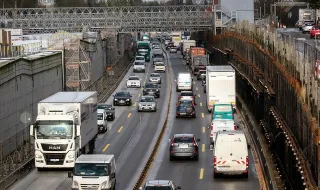
Romania is exploring the possibility of building its first motorway through a public-private partnership. The project involves the A5 Bucharest – Giurgiu expressway, which is intended to provide a direct connection to the border with Bulgaria.
Under this model, a private investor could take responsibility for financing, constructing and maintaining the route. The funds invested would be recovered through road tolls paid by drivers or through payments from the state for keeping the road operational.
No route has been selected yet
Romania’s National Road Investment Company has included in the terms of reference for the preliminary study a requirement to analyse the possibility of designing and building the road through a public-private partnership. This means that the model is still being examined and no final decision has been made for the motorway to be financed by a private investor.
The contract for the study was signed in December 2025 with the Romanian-Turkish consortium Activ Proiectare Infrastructură S.R.L. – Emay Uluslararasi Muhendislik ve Mușavirlik Anonim Șirketi. The deadline for completion is 18 months.
Seven route options are currently being assessed. Two of them will be selected to proceed to the next stage of the analysis. The project is expected to provide connections to the road network around Bucharest and to the transport corridor leading to Giurgiu and Ruse.
An easier start than the motorway to Brașov
CNIR Director General Gabriel Budescu has said that Bucharest – Giurgiu is a more suitable project for a first public-private partnership than the far more complex A3 Ploiești – Brașov motorway. The reason is that the route to Bulgaria is easier to build and could give the institutions practical experience with this model.
Contracts for similar projects in the road sector are usually signed for a period of 20 to 30 years. During this period, the private partner finances construction, maintains the road and receives revenue from its use or agreed payments from the state.
Construction sector calls for faster procedures
Romanian construction companies support the use of public-private partnerships amid the excessive deficit procedure and limited resources following the completion of the National Recovery and Resilience Plan.
“Companies are ready, but clearer documentation and institutional courage are needed,” says Cătălin Vișan, Deputy Executive Director for Operations at Concelex.
According to him, this model could ensure the continuation of investment during a period when European funding is limited or falls between separate financial programmes. For drivers, however, its possible implementation would mean that using the new route could be subject to a separate road toll.
The next key stage is the completion of the study and the selection of a preferred option. Only then will it be possible to assess whether the A5 Bucharest – Giurgiu project will be commissioned as a motorway or another high-speed road, and whether the public-private partnership will remain the chosen financing model.
Sources: money.bg, economica.net