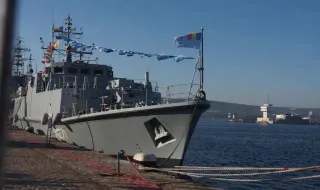
Bulgarian MEPs called for a joint European response to security threats in the Black Sea during a debate in the European Parliament in Strasbourg. The proposals included a European mission to protect commercial vessels, the accelerated establishment of a maritime security centre between Bulgaria and Romania, and stronger protection against drones.
“It is time to show that the problem in Varna, the problem in Bulgaria, the problem in Romania is a problem for all of Europe, and for the EU to send a mission to the Black Sea to protect commercial vessels,” said Andrey Novakov of the European People’s Party. According to him, the goal should be to guarantee secure deliveries without further escalation.
Nikola Minchev of Renew Europe called on Europe to invest in its common defence. He proposed a plan for monitoring and early warning, the escorting of commercial vessels, protection against drones and missiles in the event of an immediate threat, as well as joint European initiatives for radars, patrol vessels and coastal systems.
Funding for monitoring and protection against drones
European Commissioner Magnus Brunner said that drone downings, the sinking of vessels and the closure of sea routes were already affecting countries along the European Union’s eastern border. He outlined better coordination between countries, information sharing, enhanced protection at sea and in the air, and the creation of a European centre of excellence in the field of drones as priorities.
According to him, €500 million has been allocated for monitoring and countering drones along the borders. Another €50 million is intended for the establishment of a maritime security centre in Bulgaria and Romania.
Kaja Kallas said that the European Union must make joint decisions more quickly in the event of serious incidents. She pointed to the proposed emergency protocol as a possible instrument, providing for immediate political consultations and better coordination with NATO in the event of major hybrid crises.
The economic consequences for Bulgaria and Romania
Elena Yoncheva said that turning the Black Sea into a war zone was imposing a heavy economic cost on Bulgaria. She called for a special European fund to compensate the affected sectors along the western Black Sea coast and stressed that the costs of security should not be borne solely by Bulgaria and Romania.
Christian Vigenin warned that the attacks threatened freedom of navigation, increased the cost of transporting goods through Varna and Burgas, and created risks for maritime tourism and fishing. Ivaylo Valchev added that the consequences also affected energy, transport and critical infrastructure.
Stanislav Stoyanov called for diplomatic efforts and financial assistance for industries in Bulgaria and Romania that were suffering losses because of the war. He said that Europe needed diplomacy, not an expansion of the conflict.
European Parliament adopts a resolution
Two days after the debate, on 22 October, the European Parliament adopted a resolution on the escalation of Russian strikes against shipping in the Black Sea, with 432 votes “for”, 52 “against” and 88 abstentions.
The text calls for enhanced monitoring, support for Romania in building early-warning systems, and closer cooperation between the European Union and NATO. The European Parliament also called for consideration of the possibility of a European naval operation in the Black Sea to protect freedom of navigation and maritime security.
Sources: bta.bg, bntnews.bg, oeil.europarl.europa.eu