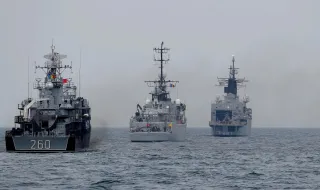
NATO is discussing ways to strengthen security in the Black Sea, but plans for a more visible Alliance presence are running up against Turkey’s caution. The discussion is taking place against the backdrop of attacks on merchant ships, violations of airspace and growing concerns about freedom of navigation.
„In recent weeks, serious things have been happening in the Black Sea, and we are working on them with Romania, Bulgaria and Turkey,“ NATO Secretary General Mark Rutte said on November 23. According to him, the threats include actions against ships, critical infrastructure and the economies of the allies.
For now, however, no permanent NATO operation in the Black Sea, analogous to Baltic Sentry in the Baltic Sea, has been announced. On November 3, NATO Assistant Secretary General for Operations Christian Buck told the European Parliament that Bulgaria, Romania and Turkey had not asked NATO to undertake a similar mission.
Bulgaria Calls for More Surveillance
Sofia has asked the allies for enhanced aerial surveillance, counter-drone systems, patrol aircraft and additional air defense capabilities. In October, Bulgaria and NATO began jointly using a P-8 Poseidon aircraft for reconnaissance over the Black Sea.
According to Bulgarian authorities, four vessels in Bulgaria’s exclusive economic zone were attacked by drones in October, two of which sank. Bulgarian Prime Minister Rumen Radev said that the country had requested assistance from its allies, but that it was being provided periodically, while the main need was for continuous surveillance of the maritime zone.
On October 28, Bulgaria, Romania and Turkey discussed establishing a coordination mechanism for a faster response to threats to freedom of navigation and maritime security. „The three countries must act together in order to respond adequately to any situation in the Black Sea,“ Bulgarian Defense Minister Dimitar Stoyanov said.
Ankara’s Role
Turkey is crucial to any NATO plan in the region because it controls the Bosporus and the Dardanelles. The 1936 Montreux Convention regulates the passage of warships and limits the presence of naval forces from countries outside the Black Sea region.
Ankara has been applying the convention since the start of Russia’s invasion of Ukraine and does not allow warships belonging to the belligerent parties to pass through the straits. At the same time, Turkey does not encourage the unrestricted entry of other NATO countries’ fleets into the Black Sea. Instead, it insists that security should be organized primarily by the coastal states.
Turkey will command NATO’s CTF Black Sea operational group until 2028, after which command is to be assumed by Bulgaria or Romania. In parallel, the three countries maintain the MCM Black Sea mine-countermeasures group.
At the end of November, former defense ministers of Bulgaria and Romania proposed a European naval mission in the Black Sea modeled on the Aspides operation in the Red Sea. The idea shows that pressure for more active protection of shipping is growing, but the future format will depend on Turkey’s consent and the limitations imposed by the Montreux Convention.
Sources: rapporteur.com, bta.bg