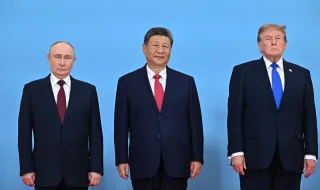
The expected “new chapter for the world” between China, the US and Russia did not materialize, despite Xi Jinping, Donald Trump and Vladimir Putin meeting on the sidelines of the APEC summit in Shenzhen. According to political scientists and analysts, the talks were a diplomatic success for Moscow, but do not show that the three countries can independently decide the fate of the world.
“There is a distance between the modern world and these three people at the large table,” political scientist Alexander Astrov says. According to him, global processes cannot be reduced to the decisions of several national leaders, because scientific research, companies and experts are often connected to more than one country.
Artificial Intelligence Requires a New Type of Coordination
Astrov cites vaccine development as an example, involving scientists and companies from different countries. According to him, the same problem can be seen with artificial intelligence, where the possible transition to superintelligence requires international coordination.
He compares the current situation with the negotiations on nuclear weapons during the Cold War. At the meeting between Leonid Brezhnev and Gerald Ford in Vladivostok, the leaders were supported by experts who knew the details of the issues under discussion. “Such a culture is not visible in the circles around these people today,” Astrov says.
Public Equality Is a Success for Putin
Political analyst Boris Bondarev rejects the claim that China’s hosting of the event was intended as a demonstration of humiliation for the Russian president. He believes that the leaders’ positions and the way they were presented to the world are more important than the symbolic details.
“When the American president calls Putin a friend and publishes a joint photograph, that is a major success for Putin,” Bondarev says. According to him, the very public placement of the Russian leader alongside Trump and Xi Jinping shows that Moscow received an important diplomatic signal of equal standing.
Bondarev describes the idea of “great powers” having the right to decide on behalf of everyone else as anachronistic. He notes that the UN Charter enshrines the sovereign equality of states, while the special powers of the permanent members of the Security Council do not constitute a universal right to determine the future of all countries.
According to him, Europe must formulate its own security objective after the war in Ukraine. The question, he says, is how to end the war in a way that strengthens the security of Ukraine and Europe, rather than that of the aggressor.
China Retains the Benefits of the Current Order
China expert Alexey Chigaдаev notes that Beijing is gradually showing a willingness to play a more active political role, but has no interest in destroying the international system. China is one of its main beneficiaries and relies on the trade and international institutions that have supported its economic growth.
China has no military treaty with Russia and does not wish to become involved in Russia’s problems. At the same time, Beijing maintains relations with Moscow, buys oil, gas, coal and fertilizers, and benefits from the restrictions on Russia’s ability to sell its resources.
According to Chigadaev, China will maintain this approach until the relationship begins to bring losses. Thus, the meeting in Shenzhen confirms Beijing’s interest in influence and deals, but not in dividing the world among three leaders.
Sources: svoboda.org