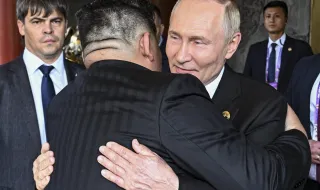
North Korea has temporarily halted military support for Russia, including deliveries of KN-23 ballistic missiles and artillery ammunition. The restrictions also include a ban on Russian military transport aircraft using North Korean airspace. This was reported by Ukraine’s Main Directorate of Intelligence.
According to Ukrainian intelligence, the decision was made personally by North Korean leader Kim Jong-un. The reason was tension that arose in October following a statement by Russian Deputy Foreign Minister Andrey Rudenko. He said that Moscow could assist in de-escalating relations between Seoul and Pyongyang.
„These statements do not correspond to the nature of the allied agreements between the two countries,“ North Korean Foreign Minister Choe Son Hui reportedly said, according to the GUR.According to Ukrainian intelligence, Choe Son Hui requested explanations regarding Russia’s policy toward South Korea and announced the temporary suspension of military support for Moscow. Pyongyang is also delaying the implementation of Russia’s request to increase the North Korean contingent in Russia from 8,500 to 50,000 troops.
North Korean units remain in Russia
Despite the restrictions, units of the 11th Corps of North Korea’s special forces continue to serve in Kursk Oblast, where they are deployed in the second echelon of the Russian „Kursk“ grouping.
A North Korean missile unit has also been stationed in Voronezh Oblast since mid-summer. The GUR claims that the Russian army is using it to carry out strikes against Ukraine. The unit operates as part of the 112th Missile Brigade of the 1st Tank Army of the Moscow Military District.
Ukrainian intelligence estimates the losses of the North Korean contingent in the fighting in Kursk Oblast at 7,058 servicemen. Of these, 2,251 are classified as irrecoverable losses, while the rest are wounded. The figures are an estimate by the GUR and have not been confirmed by either the Russian or North Korean side.
Obstacles to cooperation
According to the GUR, the expansion of military cooperation between Moscow and Pyongyang is currently limited. The reasons cited include the units’ low operational interoperability, the language barrier, a shortage of interpreters and a lack of sufficient logistical support from North Korea.
Ukrainian intelligence also claims that the senior Russian military command treats North Korean servicemen dismissively and views them as a politically imposed burden. So far, there has been no public reaction from Moscow or Pyongyang to the report of the temporary suspension of deliveries.
Sources: unian.net