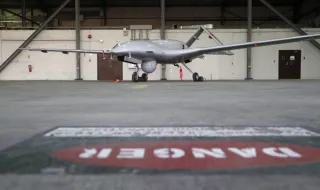
Bosnia and Herzegovina is accelerating the modernization of its armed forces with Turkish Bayraktar TB2 unmanned aerial vehicles, Kirpi 2 armored personnel carriers, Kangal anti-drone systems, new helicopters and a stationary radar for monitoring its airspace.
Defense Minister Zukan Helez said the equipment would be delivered under a military and financial cooperation agreement with Turkey. He expects the first batch of armored personnel carriers, Kangal systems, Bayraktar TB2 drones and other unmanned aerial vehicles to arrive before the New Year.
“Within a very short period, hopefully by the New Year, a contingent of Kirpi 2 transport vehicles, Kangal systems, Bayraktar TB2 drones and other smaller unmanned aerial vehicles should arrive,” Zukan Helez said.According to Bosnia’s Ministry of Defense, Turkey already delivered four Kirpi 2 armored personnel carriers in June 2025. The vehicles are intended for the protected transport of military personnel and to increase the army’s mobility. The new delivery will expand this capacity, while the Kangal systems are intended to counter unmanned aerial vehicles.
Six helicopters and pilot training
Bosnia and Herzegovina has purchased six new helicopters with its own funds and financial assistance from the United States. A contract worth more than €7.2 million has been signed to renovate the infrastructure and repair three hangars.
A shortage of aircrew remains one of the challenges facing the modernization effort. Sixty Bosnian pilots are being trained in Turkey and the United States and are expected to operate and maintain the new equipment.
Funding from NATO, the EU and the United States
Helez said that implementation of a €35 million NATO package to strengthen the country’s defense capabilities is in its final phase. International partners, together with Bosnia and Herzegovina, are also investing $7.2 million in the cybersecurity of the defense ministry and the armed forces.
Through the European Peace Facility, the country has received two €10 million tranches. A third tranche of €15 million has also been earmarked for all-terrain vehicles and protective equipment. Bosnia and Herzegovina also expects a new €20 million package, with part of the funds to be allocated for the purchase of a stationary radar.
The modernization is taking place against the backdrop of an expansion of the army’s personnel. Around 4,000 new service members have been recruited over the past four years, including 750 this year.
The army remains a joint institution in the divided country
The Armed Forces of Bosnia and Herzegovina were established in 2005 by merging the then-existing armies of the Federation of Bosnia and Herzegovina and Republika Srpska following the defense-sector reform carried out after the 1992–1995 war.
The country is not a NATO member, but it has participated in the Partnership for Peace program since 2006 and has been included in the Membership Action Plan since 2010. Integration has been hampered by political disagreements in the country, including opposition from the leadership of Republika Srpska to joining the Alliance.
At the same time, NATO maintains a headquarters in Sarajevo and supports defense reforms, modernization and the interoperability of the Bosnian army. The United States, Turkey and the European Union are among the main international partners in financial and technical assistance programs.
Sources: bta.bg, n1info.ba, klix.ba