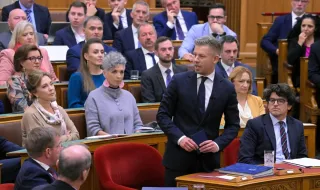
Hungary will not accept the European Union’s next budget if it provides less funding for the country or requires a larger national contribution. Prime Minister Peter Magyar made the statement in Brussels during the meeting of EU leaders.
“The most important part is still to come – the real bargaining,” Magyar said in a video address. He pointed out that Budapest insists that cohesion policy and the Common Agricultural Policy be funded at levels close to those of previous years.
The Dispute Over Money and Ukraine
The Hungarian prime minister also said that his country does not accept funding for Ukraine being linked to the next seven-year financial framework. According to him, this position is also shared by other member states.
The meeting is discussing the EU budget for the 2028–2034 period. The latest proposal is for around €1.582 trillion, with approximately €740 billion earmarked to support farmers and poorer regions. These are precisely the areas defended by the “Friends of Cohesion Policy” group.
Alongside the budget, the leaders are also discussing the provision of up to €45 billion in additional financial support for Ukraine in 2027. According to Reuters, Bulgaria, Hungary, the Czech Republic and Slovakia oppose the idea of all EU countries participating in a loan for Kyiv that would be secured through the Union’s budget.
Seeking Allies
Magyar said he had spoken with representatives of 17 EU countries united in the “Friends of Cohesion Policy” group. It also maintains regular contact with the Visegrád Four, which includes Hungary, Poland, the Czech Republic and Slovakia.
“Together, united, we are defending both cohesion policy and the interests of Central Europe,” the Hungarian prime minister said. He added that “Hungarian interests, the interests of the Hungarian people and of Hungarian businesses come first”.
The disagreement is part of a broader dispute between the countries that contribute more to the EU budget and those that receive more through the agricultural and cohesion funds. The European Council is discussing the framework for 2028–2034 with the aim of reaching a political agreement by the end of the year. The next key stage in the negotiations is the leaders’ meeting on 17 and 18 December.
Sources: bta.bg, live.euronext.com, apnews.com