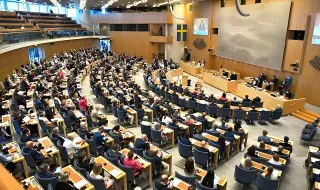
Ulf Kristersson is on the verge of securing a new term as Prime Minister of Sweden after four centre-right parties reached agreement on a common political platform. The candidacy of the leader of the Moderate Party will be put to a vote in parliament on November 30. Politico reported the agreement, as cited by News.bg.
The potential coalition includes the Moderate Party, the Christian Democrats, the Liberals and the Centre Party. The Swedish parliament has 349 seats, and the new government will not have a guaranteed majority and will have to seek support for individual bills.
“With each passing hour, we are getting closer to a government in Sweden led by a representative of the EPP,” said Tomas Tobé, vice-chairman of the European People’s Party group in the European Parliament and a fellow party member of Kristersson.
The Centre Party Changed Its Position
The key reversal came from the Centre Party. The party had long refused to join a government dependent on the Sweden Democrats — the party that supported Kristersson’s government in the previous parliament. On November 26, the leadership and parliamentary group of the Centre Party backed Kristersson’s candidacy and called on the party to vote in his favour. The decision was not unanimous, however, its leader Elisabeth Thand Ringqvist said.
The change does not mean that the Centre Party has altered its attitude towards the Sweden Democrats, Ringqvist clarified. According to her, the choice was linked to the failure of negotiations on the centre-left side.
The Election Left Sweden Without an Easy Majority
The parliamentary vote took place on September 13. Magdalena Andersson’s Social Democrats won the most votes, while the left-wing bloc secured 176 seats against 173 for the conservative-right bloc. Despite the result, Andersson failed to secure a stable parliamentary majority.
Kristersson resigned as head of government after the election, but his cabinet remained in office in a caretaker capacity. Parliament Speaker Andreas Norlén subsequently nominated Kristersson for prime minister, after attempts to form a government on the other side failed to produce results.
The upcoming vote will not end the political dependence on negotiations. If Kristersson is elected, his cabinet will have to pass its legislation with support from parties outside the coalition. If parliament rejects the candidacy and a total of four unsuccessful attempts to elect a prime minister follow, the country could be heading for an early election.
Sources: news.bg, svd.se, omni.se