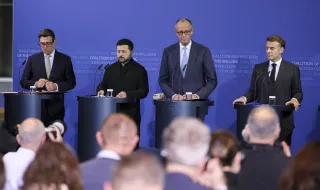
Support for military aid to Ukraine is declining in Germany, but European leaders continue to seek ways to finance Kyiv. A new survey shows that 53% of Germans are now opposed to military support, while the share of supporters has fallen to 46%, down from 59% a year earlier. The data were cited by “Politico” and published by UNIAN.
The survey was conducted in September 2026 by Forsa on behalf of the Körber Foundation among 1,501 German citizens eligible to vote. At the same time, 82% of respondents continue to view Russia as a military threat. 61% believe that Germany and Europe are not making sufficient diplomatic efforts to achieve peace between Russia and Ukraine.
The €45 billion loan remains without a final decision
Against this backdrop, the leaders of the European Union are discussing a new €45 billion loan for Ukraine in 2027. The funds are expected to cover around two-thirds of the anticipated shortfall, which, according to the cited estimates, could reach €70 billion for military and budgetary needs.
No final agreement was reached at the extraordinary meeting of the European Council in Brussels on November 26 and 27. Hungary, Slovakia and the Czech Republic must be persuaded to approve the loan. The decision is expected to be discussed again at the meeting of EU leaders on December 17 and 18.
At the same time, the EU’s next seven-year budget for the 2028–2034 period is also being discussed. European Council President António Costa is proposing a separate mechanism for paying the interest on loans to Ukraine, outside the planned €100 billion reserve.
European governments calculate the cost of retreat
According to “Politico”, Europe’s centrist leaders believe that withdrawing support could carry a higher political and financial cost than continuing the aid. Their arguments include fears that a Russian victory would increase pressure on NATO’s eastern flank, lead to new defence spending and trigger a new wave of refugees.
An assessment by the consultancy Corisk and the Norwegian Institute of International Affairs indicates that up to 10 million Ukrainian refugees could arrive in Europe in the event of a partial Russian victory. The total cost of this scenario could reach €1.6 trillion, twice as much as the cost in the event of a Ukrainian victory.
Swedish Minister for European Affairs Jessica Rosencrantz acknowledges that war fatigue among citizens is growing, but describes support for Ukraine as “vital”, rather than an optional policy. Estonian Prime Minister Kristen Michal says: “We are simply counting euros here, while they are shedding blood.” Polish Prime Minister Donald Tusk warns that the cheaper policy could turn into a much more expensive mistake, because security comes at a price.
Germany remains decisive for future funding
Berlin is Ukraine’s largest European donor, having provided €54 billion in military, financial and humanitarian aid since 2022. According to UNIAN, Germany plans to provide another €11.6 billion to Kyiv in 2027, primarily to strengthen its air defence.
Chancellor Friedrich Merz insists that long-term funding for Ukraine must be guaranteed in the EU budget. “Moscow actually wants more than just Ukraine,” he says in response to criticism that Europe is allocating too much money to the war.
Defence Minister Boris Pistorius acknowledges that the war is putting a strain on German society, costing money and causing anxiety. According to him, however, the issue is no longer limited to Ukraine, but concerns the stability of the whole of Europe.
Sources: unian.net