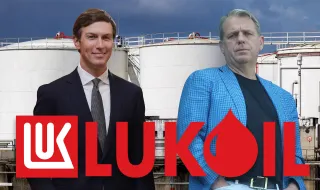
Jared Kushner, special envoy to US President Donald Trump, has embraced key elements of Russia’s interpretation of the war in Ukraine. This is the conclusion reached by The Guardian’s diplomatic editor Patrick Wintour following a 70-minute interview between Kushner and Axel Springer CEO Mathias Döpfner.
Kushner presents the conflict not as a war between an aggressor and a victim, but as the result of misunderstandings, miscalculations and accumulated mistakes in relations between Russia, the United States and Europe. According to the analysis, he has largely accepted Russia’s argument that NATO’s eastward expansion and Ukraine’s actions were perceived by Moscow as a provocation.
In the interview, Kushner calls Russian President Vladimir Putin a “grandmaster of politics” and a “historic figure”. He says that Putin has shown restraint by not using nuclear weapons and by assuring the American side that he will not do so.
The American envoy rejects an approach in which the dispute is viewed primarily through the question of who is right and who is to blame. “This is not about justice or about who is right and who is wrong. It is about stopping the killing,” he says.
The proposal for a new security framework in Europe
Kushner says that the territorial issue is at an impasse. He believes that a new European security architecture should first be agreed upon, after which the issue of the territories in Donbas can be resolved.
Among his ideas is the restoration of the Russia–NATO Council, which ceased to operate after the Russian invasion. Kushner also suggests that Ukraine could join the European Union and receive security guarantees similar to those under Article 5 of the NATO treaty. However, he acknowledges that at this stage he cannot provide details on how these guarantees would be implemented.
The Guardian notes that neither Moscow nor Kyiv has publicly accepted the approach described. According to the publication, Kushner treats Putin as a business partner who would accept a deal given the right economic incentives, rather than as a leader prepared to continue the war for territorial and historical goals.
Zelensky insists on pressure on Moscow
Kushner’s position differs from that of Ukrainian President Volodymyr Zelensky. In an interview with the BBC broadcast on November 27, Zelensky called on the United States to exert stronger pressure on Putin to end the invasion.
The Associated Press reported that Zelensky also warned of a planned Russian attack on Ukraine’s energy infrastructure, logistics and critical services. The agency said that in November, Russia carried out nearly 300 air attacks per week.
Sources: theguardian.com, apnews.com