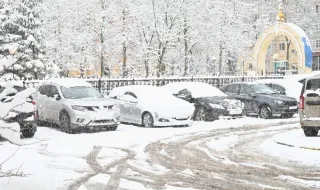
Snow and strong winds have complicated weather conditions in several Balkan countries. Snowfall has been recorded in Serbia, Croatia and Bosnia and Herzegovina, with snow cover already forming in some areas.
Belgrade and its surroundings turned white, while Serbian authorities urged drivers to reduce their speed, use winter tires and comply with restrictions on intercity roads. “Roads of Serbia” also appealed to road users not to set off without winter equipment and to adjust their speed to the road conditions, BTA reported.
There is a discrepancy in descriptions of the precipitation around the Serbian capital. While snowfall has been reported in Belgrade and the surrounding area, official road information indicates that precipitation in the city itself is mostly rain, temporarily sleet, while snow is more likely in areas south of the capital. Snowfall is expected in the rest of Serbia south of the Sava and Danube rivers, in some places with greater intensity, along with the formation of snow cover.
In Croatia, snow is falling in Zagreb, central Croatia, Podravina and Slavonia. In higher areas, snow cover has reached between 10 and 20 centimetres. Temperatures in most of the country are between 0 and 3 degrees, while along the coast they range from 9 to 14 degrees.
Yellow, orange and red warnings for strong winds have been issued in parts of Croatia. Gusts are expected to reach up to 165 kilometres per hour in some areas. The State Hydrometeorological Institute has also forecast a further drop in temperatures over the coming days.
Snow and rain are also falling in Bosnia and Herzegovina. The weather in Sarajevo is mostly cloudy, with snowfall, while temperatures across the country range widely – from minus 4 degrees to 14 degrees in the southern regions.
Winter conditions are also expected in Bulgaria
Cold air from the north-northeast is also affecting Bulgaria. The National Institute of Meteorology and Hydrology has forecast significant rainfall turning to snow, as well as the formation of snow cover. In the Pre-Balkan region, it may exceed 30 centimetres, while strong winds are creating conditions for blizzards and snowdrifts in a number of areas.
In Serbia, snowfall is expected to weaken significantly and stop around noon on 29 November. Until then, road authorities are warning of icy conditions, reduced visibility and difficult traffic in the affected areas.