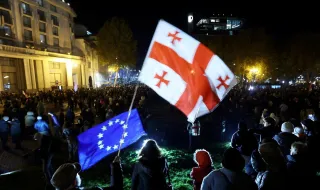
Tens of thousands of supporters of Georgia’s opposition gathered in Tbilisi for a pro-European demonstration marking the second anniversary of the start of mass protests against the freezing of talks on the country’s membership in the European Union.
Participants set off from three locations in the capital – outside Tbilisi State University, near Avlabari metro station and from Orbeliani Square. The marches headed towards Freedom Square, which was filled with Georgian and European flags. Civil society activists, non-governmental organisations and representatives of opposition parties took part in the protest.
The demonstrators called for new parliamentary elections and the release of people detained during previous demonstrations. The protest was organised by pro-European activists and five opposition parties, against which the ruling Georgian Dream party has filed a case with the Constitutional Court.
The organisers accused the ruling party of betraying the country’s European and Euro-Atlantic course, enshrined in the Georgian Constitution. They said: „Let us show the world that we are not giving up and will not submit.“
How the protests began
The political crisis deepened after the parliamentary elections in October 2024, whose result was challenged by the opposition. On 28 November of the same year, Prime Minister Irakli Kobakhidze announced that the government would not raise the issue of opening EU membership talks until the end of 2028.
The decision sparked mass demonstrations, which were forcibly dispersed by police. The protests subsequently continued on a daily basis, while the demands expanded to include calls for new elections, legislative changes and the release of political prisoners. According to ACLED data, 1,371 protest events were recorded in Georgia between 28 November 2024 and 19 November 2026, compared with 552 during the previous two years.
The case against the opposition parties
The Constitutional Court is considering a request by the ruling party to ban the United National Movement, Coalition for Change, Strong Georgia – Lelo, the Federalists and For Georgia. According to Georgian Dream, these parties violated the Constitution and sought to change the constitutional order. Opposition leaders reject the allegations and claim that the court case is aimed at removing the main political competitors ahead of the next parliamentary elections in 2028.
The court is expected to rule by June 2027. The European Parliament condemned the initiative, while Brussels said Georgia remains a candidate for membership „in name only“ because of its retreat from democratic standards. Prime Minister Kobakhidze rejects the criticism and said that the government remains committed to the constitutional goal of joining the European Union.
Sources: nova.bg, arabnews.com, apnews.com