China said that “unification” with Taiwan cannot be stopped after the ruling Democratic Progressive Party doubled the number of local administrations under its control but failed to win the capital, Taipei. The position was announced by a spokesperson for the Taiwan Affairs Office of China’s State Council.
“Regardless of how Taiwan’s political landscape changes, this cannot alter the direction and trend of cross-Strait relations, nor can it stop the historical trend toward the inevitable reunification of the homeland,” the Chinese side said.Beijing added that it would continue to uphold the one-China principle and the so-called 1992 Consensus, as well as deepen exchanges and cooperation across the Strait. China’s position does not represent a change in its official view that Taiwan is part of Chinese territory.
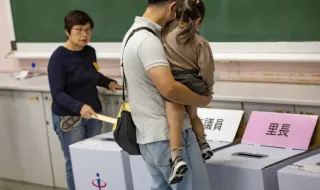
In the November 28 vote, the Democratic Progressive Party won 10 of the 22 mayoral and gubernatorial posts. The Kuomintang won 11, while one post went to an independent candidate. Thus, the ruling party increased its representation compared with the 2022 elections, when it controlled only five local administrations.
The Democratic Progressive Party regained Taichung and won five more areas, including Changhua, Yilan, Hsinchu County, Chiayi City and Yunlin. The Kuomintang, however, retained Taipei, New Taipei, Keelung and Taoyuan, while the capital’s mayor, Chiang Wan-an, was re-elected to a second term.
Taipei remains in the opposition’s hands
Chiang Wan-an’s victory was one of the most closely watched results. Democratic Progressive Party candidate Shen Po-yang, known for his tough stance against Chinese pressure and his work on issues related to information warfare, conceded defeat.
The elections were for mayors, local leaders and municipal councillors, not for president or parliament. The campaign was dominated mainly by issues such as transport, the environment, social services and city governance. Nevertheless, the vote is also viewed as an important signal ahead of the presidential and parliamentary elections in January 2028.
Beijing intensifies its message ahead of 2028
China’s reaction comes amid continuing political divisions in Taiwan. The Democratic Progressive Party holds the presidency but does not have a majority in parliament, where the Kuomintang and the Taiwan People’s Party cooperate on a number of issues.
According to an analysis by the U.S.-China Economic and Security Review Commission, Beijing is likely to use the results of the 2026 elections and the upcoming 2028 presidential vote to assess whether political pressure could bring Taiwan closer to China’s position. The same analysis notes that Taiwanese society remains predominantly opposed to political integration with China.
A survey conducted in November by Taiwan’s Mainland Affairs Council shows that 71.8% of respondents support maintaining the status quo in cross-Strait relations. The data point to a divergence between Beijing’s insistence on unification and the prevailing public preference in Taiwan not to change the current political model.
Sources: reuters.com, focustaiwan.tw, apnews.com