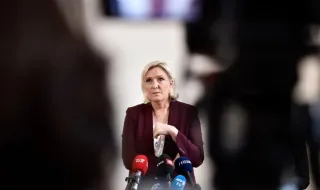
Marine Le Pen has made the future of the European Union one of the main stakes in France’s 2027 presidential election. The leader of the National Rally insists that the bloc’s new seven-year budget must not be finalised before the vote and warns that approving it in advance would be a “democratic scandal”.
The first round of the election is scheduled for 18 April 2027, and the second – for 2 May. Following the appellate court’s decision in July, Le Pen retained the possibility of taking part in the race, while current political forecasts place her among the leading candidates.
The Dispute Over France’s Money
Le Pen is threatening to drastically reduce France’s contribution to the EU budget if she is elected president. Her party has proposed unilaterally cutting the payment by €11 billion as early as 2027. The French parliament, however, rejected the idea and approved an increase in the contribution of around €2.1 billion.
The draft French budget for 2027 estimates the payment to the European Union at €30.906 billion. This very gap between the officially planned funds and the proposal of the National Rally has turned the budget into a potential first crisis between Paris and Brussels in the event of a Le Pen victory.
In an analysis by the Financial Times, her political strategy is described as the most serious populist challenge to the European project to date. Le Pen herself speaks of a “test of strength” between France and the European institutions.
Ukraine, Migration and a “Europe of Nations”
Le Pen’s programme envisages a change in policy towards Ukraine, curbs on migration, a review of the primacy of European law and a reduction in the size of the European institutions. She also opposes any further enlargement of the EU.
Her position on Ukraine has changed. In November, Le Pen said that France would continue providing material and humanitarian aid if she were elected, but would not undertake new financial commitments beyond those already approved. She also opposes sending French troops.
French Minister for European Affairs Benjamin Haddad warned that a National Rally government could lead to a “real or covert Frexit”. “From an ideological point of view, she is opposed to the European project and would trigger a crisis within the EU,” Haddad said.
Brussels Prepares for a Possible Change
European governments are discussing how the rules currently in force could limit unilateral decisions by a future French government. Paris is one of the EU’s largest economies and military powers, which is why a confrontation with Brussels would have broader consequences than the conflicts to date with Eurosceptic governments.
On 26 November, European leaders backed Spaniard Pablo Hernández de Cos as the next president of the European Central Bank. He is expected to succeed Christine Lagarde on 8 February 2027 – before the French vote and at a time when financial markets will be closely watching the prospect of a Le Pen government.
Supporters of closer European integration hope that France’s economic dependence on the single market will force Le Pen to soften her plans, as they believe happened with Italian Prime Minister Giorgia Meloni. The National Rally rejects the comparison and insists that Le Pen will fulfil her promises.
Sources: focus-news.net, apnews.com, lemonde.fr