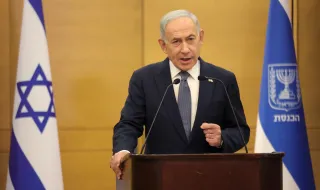
Benjamin Netanyahu and his main political rival, Gadi Eisenkot, met in an attempt to reach an agreement on a national unity government. Netanyahu’s proposal is for Eisenkot to serve as prime minister first, while he himself would take the post of deputy prime minister at the beginning of the term.
This marks a substantial change from the previous position of the Likud leader, who had insisted on leading the next government as the leader of the largest party. Netanyahu justified the concession by saying that Israel needs a government capable of responding to the threats facing the country. “My responsibility as a leader requires me to set everything aside and agree to Gadi Eisenkot becoming prime minister first, while I serve as deputy prime minister,” he said.
Eisenkot, who received a mandate from President Isaac Herzog to form a government, agreed to hear the proposal but set a short deadline for Likud to demonstrate the seriousness of its intentions. “If Likud is ready for genuine unity, I am ready to see how serious this is over the next 24 hours,” he said.
Majority remains out of reach
Following the election, neither of the two main political camps has the necessary support. A majority in the 120-seat Knesset requires 61 lawmakers. Eisenkot’s Yashar party has agreed to cooperate with the Democrats and the right-wing Yisrael Beiteinu, but the three formations hold a total of 36 seats.
Eisenkot must present a government by December 6. The president can extend the deadline by another 14 days, but political pressure on the candidate is mounting. He must bring together the support of different parties without losing allies who do not want a coalition either with Likud or with the Arab formations.
Two days before the meeting, Eisenkot accused Likud of delaying the negotiations in order to push the country toward new elections. Netanyahu’s party has not publicly presented a final coalition proposal that would overcome the disagreements between the political camps.
Rotation already has precedents
Israel has already used a rotating prime minister formula three times. In 1984, Shimon Peres of the Maarach bloc served first, and in 1986 he handed the post to Likud’s Yitzhak Shamir.
The more recent example is the agreement between Naftali Bennett and Yair Lapid. Bennett was prime minister from June 2021 for one year, after which Lapid took over the post until the 2022 election. The previous agreement between Netanyahu and Benny Gantz in 2020 fell apart over a dispute regarding the budget.
The current talks will show whether the new proposal can overcome the disagreements over the coalition’s composition and policies. If Eisenkot fails to secure the necessary support within the set deadline, Israel could face a new stage of political deadlock.
Sources: dailymail.com, apnews.com, timesofisrael.com