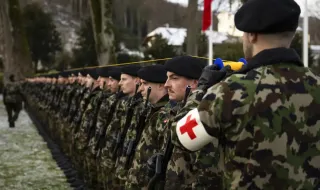
Swiss voters approved the amendment to the Military Materials Act by 54.3 percent. Voter turnout in the referendum was 48 percent.
The new rules ease the export of weapons, weapons systems and military components to 36 Western partner countries. The list includes all countries of the European Union and the European Free Trade Association, as well as Argentina, Australia, Canada, New Zealand, Japan, the United Kingdom and the United States. Bulgaria is also among the countries covered by the changes.
Deliveries may also be authorized when the partner country is involved in an armed conflict, but only if this is compatible with Swiss neutrality and the country’s foreign policy and security interests. The Federal Council retains the right to block specific deals.
Ukraine remains outside the scope
The change does not allow direct or indirect deliveries of Swiss weapons to Ukraine. According to the Swiss authorities, neutrality and the rules on equal treatment of countries in an international armed conflict continue to prohibit such deliveries.
The approach to re-export ban declarations is also new. Buyers will not have to provide such a guarantee in every individual case. However, the Federal Council may require one when there are foreign policy, neutrality-related or security-related grounds. The restrictions also remain in force when there is a risk that Swiss military equipment could be forwarded to a country at war.
“The Federal Council is pleased with the result,” said the President of Switzerland and Minister of Economic Affairs, Guy Parmelin. According to him, the changes will be applied “with restraint,” and the decision gives the country the means to protect its security without abandoning its moral principles.
Pressure on Switzerland’s arms industry
The referendum followed a parliamentary decision of December 19, 2025. Switzerland’s European partners warned that they could stop buying its military products if, in a crisis situation, they were unable to forward the equipment they had purchased or if spare-parts deliveries were blocked.
In April 2026, the referendum committee submitted 58,952 signatures opposing the changes. After verification, 58,767 of them were deemed valid. In Parliament, the bill was backed by 122 votes to 68 in the National Council and by 31 votes to 11 in the Council of States.
Supporters of the change, including the Swiss People’s Party, the Free Democratic Party, the Centre party and the Green Liberal Party, argued that more flexible rules were needed to supply the army and to enable Swiss industry to participate in international production chains. Opponents from left-wing parties, peace organizations and non-governmental organizations warned that weakening controls could increase the risk of Swiss weapons ending up in bloody conflicts.
“People who believe that a change in security policy is necessary have been mobilized,” commented analyst Lukas Golder of GFS Bern. He described the decision as a “quick fix” that gives the Federal Council greater freedom of action.
Sources: srf.ch