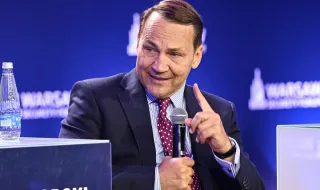
Russian President Vladimir Putin is probably still hoping to break the Ukrainians over the winter, which is why Moscow is setting “absurdly unrealistic” conditions for negotiations. This was stated by Polish Foreign Minister Radosław Sikorski, as quoted by UNIAN.
“It is possible that only if he fails to break them will he be ready for serious negotiations, because today he is making absurdly unrealistic demands,” Sikorski said.
According to him, the Russian position follows a model familiar from Soviet diplomacy – to ask for as much as possible in the hope that the other side will make significant concessions. “The tradition of Soviet diplomacy is to ask for 1000%, hoping that the other side will give 50%,” the Polish minister said.
Sikorski: Europe is defending itself, Russia is threatening
Sikorski rejected Russia’s claims that Moscow has no aggressive intentions toward its neighbours and wants a new security architecture. He recalled an old joke according to which the “secure border of the Soviet Union” is the one with Soviet soldiers standing on both sides of it.
The Polish foreign minister said that Russia is threatening the West and carrying out actions that, in his view, undermine security, while European countries are adhering to a defensive policy. He pointed out that democratic states do not have secret units that can be sent to Moscow, and denied that Europe is seeking attacks against Russian shopping centres or trains.
Kyiv proposes negotiations along the current front line
Ukrainian President Volodymyr Zelensky said that his country was ready to cease fire along the line of contact and move on to diplomatic talks. He acknowledged that such an approach would be a “very major compromise”, but presented it as a possible way to start a political process if Russia does not want to withdraw its troops from Ukrainian territory.
This position was also supported in a joint statement by France, Germany, the United Kingdom and Ukraine on 8 June 2026. The four countries identified the current line of contact as a possible starting point for negotiations, while insisting at the same time that international borders must not be changed by force.
On 19 November, Zelensky said that Russia had rejected proposals for limited de-escalation in the energy sector, the Black Sea and other formats. It was also reported at the time that European countries, the European Union and NATO would participate in future negotiation formats.
In the same context, US President’s special envoy Jared Kushner said that, in his view, an alleged Ukrainian attack on Putin’s residence had delayed the diplomatic process. Kushner identified the territorial issue as the main obstacle, but the publication did not present independent data confirming his claim about the attack.
Sources: unian.net