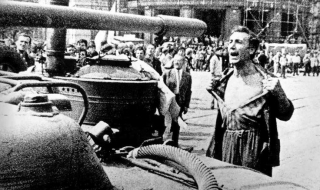
The period of political liberalization in Czechoslovakia, which began on January 5, 1968 and lasted until August 20 of that year, when the Soviet Union and the Warsaw Pact allies (except Romania) occupied the country, is called the Prague Spring. Bulgaria was then the first country to insist on military intervention in Czechoslovakia and the last to apologize for its participation in the suppression of the Prague Spring with a parliamentary decision in 1990 and later during the presidential visit of President Petar Stoyanov to Prague in 1997.
After the end of World War II, Czechoslovakia entered the Soviet sphere of influence, the so-called Eastern Bloc. Before the war, the country was one of the most highly developed industrial countries in Europe, but socialism led it to a deep economic crisis. Unlike other countries in Central and Eastern Europe, in Czechoslovakia the communists came to power in the form of a popular movement. In 1948, a one-party system was imposed in the country and power was under the control of the Communist Party, which was under direct control of the Soviet Union. The reforms in the country did not lead to mass protests, as in neighboring Hungary.
There are two reasons why the communist movement received the support of a part of the people:
As the end of World War II approached, Stalin signed an agreement with Churchill and Roosevelt, according to which Prague should be liberated by the Red Army, although American troops, under the command of General Patton, could have liberated the city earlier. Stalin did not fulfill the agreement, which stated that after the war the country would be governed by a democratic government, which he himself did not allow. This also explains the later pro-Russian (pro-communist) propaganda after the war.
Another reason is the passivity of the West during the Munich Agreements, which gave its consent to Nazi Germany to occupy the Sudetenland.
These are the two factors that influenced the people in the elections of 1948 - the last democratic elections in Czechoslovakia for a long period.
From the mid-1960s, the people's dissatisfaction with the existing regime began to be felt more and more often in the country. Reforms began within the Communist Party itself, which led to the election of Alexander Dubček as the party leader. Dubček's reforms were a long political process, which he himself called ‘socialism with a human face’. These reforms are not aimed at completely rejecting the old regime, as in Hungary since 1956, but have broad support from society, including the working class.
The paranoid leaders in the Kremlin consider the reforms being carried out in Czechoslovakia as a rejection of their hegemony over Czechoslovakia, as a threat to the entire Eastern Bloc and to the security of the Soviet Union itself. Czechoslovakia is located in the middle defensive line of the Warsaw Pact and its possible crossing to the West increases the threat to the Soviet Union, which is unacceptable during the Cold War.
On the other hand, a significant minority of hardliners in the Czechoslovak Communist Party collaborate with the USSR, with which they aim to slow down the reforms being carried out. Hardliners viewed with fear the widespread popular support for Dubček's reforms.
Soviet policy in the Eastern Bloc was to support pro-Soviet communist regimes in those countries and to use military force if Soviet hegemony was threatened. This doctrine is known as the ‘Brezhnev Doctrine’ after the Soviet leader who first announced it, although the doctrine had been in effect since Stalin's time. This doctrine remained in effect until the 1980s, under Mikhail Gorbachev.
Soviet leaders first tried to pressure Czechoslovakia to abandon or limit its reforms through negotiations. When their attempts failed, they began to undertake military intervention.
On the night of August 20-21, 1968, the troops of the Eastern Bloc from five Warsaw Pact countries, including Bulgaria, invaded Czechoslovakia. The so-called Operation "Danube" was carried out. During the invasion, from 5 to 7 thousand Soviet tanks and from 300,000 to 600,000 soldiers from the Warsaw Pact units occupied Czechoslovak territory. According to official Soviet authorities, their troops were "called" by the Czechoslovak communists, who had sought "fraternal assistance against the counter-revolution".
Bulgaria sends a tank brigade of 33 T-34s. Over 100 people lose their lives during the invasion. Alexander Dubcek calls on the people not to resist. After the suppression, he is captured and sent to Moscow, along with several other comrades, where he is forced to sign a protocol recognizing the invasion of Czechoslovakia.
The Western countries only verbally condemn the invasion - the reality of the nuclear threat during the Cold War puts them in a position where they are unable to push out the Soviet troops. Unexpectedly, the leader of the communists in Romania, Nicolae Ceausescu, a fierce opponent of Soviet influence, came out in support of Dubcek and gave a public speech in Bucharest on the very day of the invasion, condemning Soviet policy.
The occupation forced 70,000 to 300,000 people to emigrate to the West, mostly highly qualified people. Western countries accepted these emigrants without any obstacles.
The events surrounding the Prague Spring disappointed many Western leftists and contributed to the collapse of many of these parties in Western European countries. Eurocommunists and a number of left-wing intellectuals distanced themselves from the actions of the communist parties in the socialist countries. One of them is the famous singer and actor Yves Montand, who even starred in the film “Confession“, mercilessly exposing the actions of the communist dictatorship in Hungary in 1956 and Czechoslovakia in 1968.