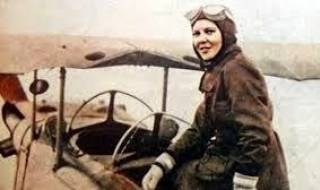
On March 22, 2001, one of Mustafa Kemal Atatürk's eight adopted daughters, Sabiha Gökçen, died.
She is known as the first female fighter pilot, but she even participated in combat operations. In her professional career in the Turkish Air Force, Sabiha has over 8,000 flight hours, piloted 22 different types of aircraft, and performed 32 hours of combat bombing flights.
Sabiha is the daughter of ethnic Bosniaks Mustafa Izet Bey and Hayriye Hanum, who died during World War I. In 1925, during Atatürk's visit to Bursa, 12-year-old Sabiha asked permission to speak to Atatürk and expressed her desire to study at a boarding school.
After learning her story and her miserable living conditions, Atatürk in turn asked her brother for permission to take her to the presidential residence in Çankaya in Ankara. There, he adopted her and she lived with the president's other adopted daughters, Zehra, Afet and Rukie (Erkin).
Sabiha completed her primary education in Ankara, then continued her studies at the famous girls' college located in the Üsküdar district of Istanbul.
On December 19, 1934, Atatürk succeeded in introducing the mandatory use of surnames into Turkish law and Sabiha received the surname Gökçen (Gök - sky), but it still had nothing to do with the sky and aviation. In fact, Atatürk gave her the surname of the fighter against the Greek intervention, Gökçen Efe, who died and entrusted his two children to Celal Bayar, an associate of Atatürk.
Atatürk attached great importance to aviation and for this purpose led the founding of the Turkish Aviation Association as early as 1925. He took Sabiha with him to the opening ceremony of the “Türkkuşu” (Turkish Birds) Aviation School on May 5, 1935, with the air show featuring unpowered aircraft and parachutists invited from abroad.
Atatürk noticed the immense excitement that the demonstrations caused in Sabiha and asked her if she wanted to become a pilot. She nodded eagerly and said, “Yes, I’m ready now.”
Ataturk ordered the director of the aviation school, Fuad Bulca, to enroll 22-year-old Gökçen as the first female cadet, and after intensive training, she soon received her pilot’s license.
Sabiha was sent to the Soviet Union with seven other young people to train in unmanned flying. While in Moscow, she learned that Zehra had died and immediately returned to Turkey, temporarily postponing her studies.
In early 1936, Ataturk convinced her to enroll in the Air Force Academy to become the first female military pilot in Turkey. There, she improved her flying skills and began to fly bombers and fighters well at the Eskisehir air base. She also gained experience in the exercises held in the Thracian and Aegean regions of Turkey in 1937. In the same year, she took part in the military operation against the rebellious Dersim Kurds. A report from the General Staff noted her bombing of "bandits". For her participation in this operation, she was awarded the Medal with Precious Stones by the Aviation Association.
In 1938, Sabiha made a five-day tour of the Balkan countries, during which the 25-year-old Turkish woman caused a real sensation and significantly improved the image of her country in the process of Europeanization.
Later, she was appointed chief training instructor at the Türkkuşu Aviation, where she served until 1955. She personally trained four Turkish girls as aviators – Edibe Subaşı, Yıldız Uçman, Sahavet Karapaz and Nezin Viraniali. She became a member of the Executive Board of the Aviation Association.
Sabiha Gökçen traveled the world for 28 years (until 1964) as a visiting card of her country. Her book “Life on the Road of Atatürk” was published in 1981 by the Turkish Aviation Association in honor of the 100th anniversary of Atatürk's birth.
Now the second international airport of Istanbul on the Asian coast is deservedly named “Sabiha Gökçen”, the website Hedgehog recalls.
In 1996, the US Air Force Academy distinguished her as the only woman among the “20 greatest pilots in the history of military aviation”.