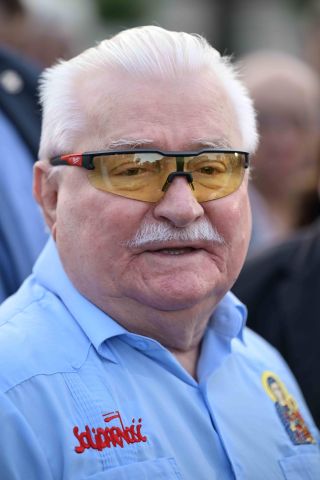
On October 5, 1983, the Polish dissident Lech Walesa was awarded the Nobel Peace Prize. He is the latest dissident from Eastern Europe to receive this award. Lech Walesa was born in the village of Popowo, near Lipno, near Mokowo on the Vistula. After studying to be an electrical engineer, he worked at the Gdańsk shipyard from 1967 - 1976, but was fired for criticizing the management. He remained in contact with the shipyard workers in 1979 - In 1980, he created a strike committee that sought greater civil rights and higher wages to meet the rising prices of food and basic necessities.
On 31 August 1980, an agreement in Gdańsk between Wałęsa's committee and the Polish government paved the way for the creation of an independent trade union called "Solidarity" (Solidarność), with Wałęsa as its leader. Opposition from General Wojciech Jaruzelski led to Wałęsa's arrest and internment from December 1981 to November 1982. Upon his release, he managed to rein in the more unruly members of "Solidarity" by negotiating with General Jaruzelski and his ministers.
In October 1983, Wałęsa was awarded the Nobel Peace Prize. His wife and son traveled to Oslo to receive it and to read Walesa's address on civil rights. He was then allowed greater freedom of movement, even visiting Rome. He took a leading role in negotiations with the Polish government between February and April 1989 and in organizing Solidarity's public campaign for the June 1989 general elections.
He was elected President of Poland in December 1990. However, his term was not smooth. He often complained that the left-wing coalition was hindering economic reforms. The anti-socialist Catholicism of Solidarity, which had brought him to power, was no longer dominant in political attitudes by November 1995, when Walesa was defeated as a candidate for a second term.