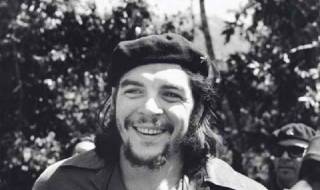
On October 8, 1967, the guerrilla commander Che Guevara and his associates were captured near La Higuera in Bolivia.
The action was organized by the CIA. The next day, October 9, on orders from Washington, Ernesto Che Guevara was shot and the Bolivian government announced the execution. On October 15, Cuban leader Fidel Castro officially announced the death of Ernesto Che Guevara.
Ernesto Che Guevara was born in Argentina into a relatively wealthy family of Irish-Spanish aristocratic origin. He grew up in an environment with left-wing political beliefs. He graduated from medicine in Buenos Aires, but hardly practiced because he devoted his life to the revolutionary struggle.
Severe asthma attacks from early childhood forced him to follow a diet and undergo various medical treatments. At the same time, the disease taught him discipline and self-control. From an early age, he was distinguished by a free and rebellious spirit and had long discussions with his teachers and parents.
At the age of 17, he showed interest in philosophy, even began to compile his own philosophical dictionary. He undertook several trips to Central and South America. He witnessed injustice, poverty and came to the conclusion that the only way out of the problem of social inequality was armed revolutionary struggle.
He was in Guatemala during the 1954 coup and the dictatorship that followed. He was forced to flee to Mexico. There he met Fidel Castro and became a member of the July 26 Movement, which seized power in Cuba in 1959. Under Guevara's leadership, many people, including political dissidents, were killed in the La Cabaña fortress.
As a member of the national leadership of the United Party of the Socialist Revolution, he held various government positions, such as: President of the National Bank (1959) and Minister of Industry (1961-1965). Ernesto Che Guevara also played a significant role in Cuban diplomacy in the period 1959 – 1964
Then he made a diplomatic tour of Asia and Africa, headed an economic delegation to the Soviet Union, China and North Korea, represented Cuba at a conference on economic planning in Algiers, at the 19th session of the UN General Assembly in New York and at a UN conference on trade and development in Geneva.
Ernesto Che Guevara renounced his Cuban citizenship and all his posts in the state and left Cuba in 1965, hoping to help the revolutionary guerrilla struggle around the world and ignite new social revolutions in other countries - first in the Congo, and then in Bolivia, where he was captured by the CIA in a special military operation and killed.
For many people, Che is a symbol of the continuous opposition to the people's oppressors in the countries of Latin America and Africa and of the struggle for social equality. He is called the last revolutionary romantic.
His name has become synonymous with a rebellious and revolutionary spirit. His complete rejection of the affluence provided by his political position in post-revolutionary Cuba is memorable, in favor of pursuing the ideal of changing the way countries are governed not only in Latin America, but throughout the world.
During his lifetime, Che Guevara won the sympathy of even representatives of the capitalist camp. Here is what is written about him in a report by the British Foreign Office on the most influential figures in Cuba from 1967: “He is a capable and hardworking man and is perhaps the most competent and sober-minded in ruling circles”. This bearded Argentine with his characteristic military uniform and Irish charm makes a significant impression on many women and men. By 1964, he was probably the most influential person in Cuba after Fidel Castro.