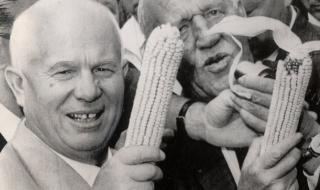
On September 13, 1953, Nikita Khrushchev was elected General Secretary of the CPSU Central Committee. He was born on April 17, 1894 in the village of Kalinovka, Kursk province, located near the Ukrainian border. He came from a working-class peasant family. At an early age, he was a shepherd, and then worked as a mechanic in the factories and mines of the Donbass from 1908 (when he was barely 14 years old), later he was a participant in the Civil War (1918-1920). In 1929, Khrushchev entered and studied at the Moscow Industrial Academy until 1931, leaving it to work in the Moscow party apparatus (1931-1935).
In 1934, Nikita Khrushchev became a member of the Central Committee of the party, and from 1938 to 1947 he was First Secretary of the Central Committee of the Ukrainian Bolshevik Party.
During the period 1935-1938, N. Khrushchev was First Secretary of the Moscow City Party Committee.
During World War II, Khrushchev was a party commissar at the front and reached the military rank of lieutenant general in 1943.
During the Great Patriotic War of 1941-1945, Nikita Khrushchev served in the army. He was a member of the Kiev Military Council. He took an active part in the defense of Stalingrad and in the preparation of the defeat of the German troops near the city.
After the war, Khrushchev was elected Secretary of the Central Committee of the All-Union Communist Party (Bolsheviks) in December 1949 and simultaneously in the period 1949-1953 was First Secretary of the Moscow Committee (MC) of the party. As a senior party functionary, he was involved in the organization and conduct of mass repressions against party, state and military functionaries on the eve of World War II and after it.
In March 1953, at a joint meeting of the Plenum of the Central Committee of the CPSU, the Customs Council of the USSR and the Presidium of the Supreme Soviet of the USSR, it was found necessary for Khrushchev to concentrate on the work of the Central Committee of the Communist Party, in connection with which he was relieved of his duties as First Secretary of the Central Committee of the party.
After the death of Joseph Stalin, Nikita Khrushchev was elected First Secretary of the Communist Party of the Soviet Union from 1953 to 1964 and Chairman of the Council of Ministers of the USSR from 1958 to 1964. In 1959, he received the Lenin Peace Prize.
He organized the exposure of Stalin, revealing the horrors of his dictatorship to the world in a report at a closed meeting at the Twentieth Congress of the CPSU in February 1956. Thus, Khrushchev began the liquidation of the "cult of Stalin's personality" and tried to introduce democracy into the totalitarian system. After the Twentieth Congress of the CPSU, he released all political prisoners sentenced during the "cult of personality". He introduced a certain order and began to exercise control over the work of the state security organs. Under Khrushchev's leadership, there was relative creative freedom for intellectuals.
Using the capabilities of the planned economy, Khrushchev attempted to stimulate agriculture, with which the USSR could overtake the United States in agricultural production, and poured huge funds into the development and utilization of new agricultural lands in Kazakhstan.
Nikita Khrushchev was removed from office and retired by decision of the October Plenum of the CPSU Central Committee in 1964. He died in Moscow on September 11, 1971. He was buried at the Novodevichy Cemetery in Moscow without a state ceremony.