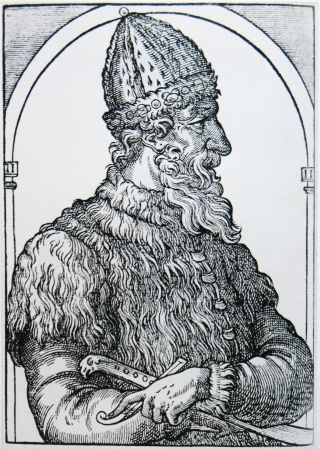
On October 27, 1505, Ivan III the Great dies. He was the Grand Prince of the Principality of Moscow from 1462 to 1505. He managed to annex almost all the Great Russian regions to the Principality of Moscow, laying the foundations of today's Russia. Taking advantage of the collapse of the Golden Horde, Ivan III put an end to the two and a half centuries of dependence of the Russian lands on the Mongols.
Married to Sophia Paleologina - niece of the last Byzantine emperor, Ivan III also laid the foundation for Russia's imperial claims. He included the double-headed eagle of the Eastern Empire in his coat of arms, and on a preserved seal of his from the end of his reign he used the title “Ivan, by God's grace, master of all Russia and grand prince of Vladimir and Moscow, and Novgorod, and Pskov, and Tver, and Ugric, and Vyatka, and Perm, and Bulgarian“. In some documents he is even called tsar.
In 1467 his wife Maria Borisovna died, leaving him with one son, Ivan the Younger. In 1469 he received an offer from the Pope to marry Zoe Palaeologus. She was the daughter of Thomas, despot of the Morea and brother of the last Byzantine emperor Constantine XI Dragash, who after the fall of Constantinople in 1453 lived in Rome with her family. In 1472, the two married in Moscow, and she took the name Sofia.
During the reign of Ivan III, the Moscow Principality managed to throw off its two and a half centuries of dependence on the Mongol Empire and its successors.
As the Moscow Principality grew stronger, it gradually gained prominence in Europe. In addition to the Papal Curia, it established diplomatic relations with the Holy Roman Empire, Hungary, and Moldova, with Emperor Maximilian I even calling Ivan III his "brother" in their correspondence.
Ivan III concluded an alliance with the Danish King Hans against Sweden. He built the fortress of Ivangorod in Ingria, which proved particularly useful in the subsequent Russo-Swedish War, which began after the expulsion of the Hanseatic merchants from Novgorod.
The further expansion of Muscovite possessions to the west was facilitated by the death of Kazimierz IV in 1492. The new Grand Duke of Lithuania, Alexander, was weak and indecisive, and tried to protect himself from the attacks of the Principality of Moscow by marrying Elena, daughter of Ivan III. However, his father-in-law's aggressive behavior continued, and in 1499 the two countries were again at war. In 1500, the Lithuanians suffered a defeat at Vedrosha, and in 1503 Alexander concluded peace, ceding to the Principality of Moscow Chernigov, Novgorod Seversky, Starodub, Gomel, Bryansk, Toropets, Mtsensk, Dorogobuzhi, and others. At the same time, the Livonian Order began to pay tribute to Moscow.
The reign of Ivan III was also associated with a significant centralization of the state, as the foundations of the Russian autocracy were laid. He began to build the central apparatus of power, the Code of Laws of 1497 was compiled. The old patriarchal system of government was abolished and the monarch no longer consulted the boyars on political issues. Their rights were severely limited, as they were placed under the ruler's control.
After 1485, the architectural complex of the Moscow Kremlin took shape. The Ivan the Great Bell Tower, the Palace of the Faces, and others were built there, and in 1479 the construction of the stone Assumption Cathedral was completed. By order of Ivan III, the Byzantine monk Maximus the Greek translated Greek and Latin church books into Russian.
The last years of Ivan III's reign were associated with palace intrigues surrounding his succession. Under pressure from his second wife Sophia, the first-born son Dmitry, who was initially designated as the heir, was removed. Ivan III's first son by Sophia, Vasily, was declared the heir to the throne.
Ivan III died on October 27, 1505. He was buried in the Archangel Cathedral of the Moscow Kremlin.